Bumthang Valley: Bhutan’s Sacred Spiritual Heartland
The morning mist was still clinging to the valley floor when I first saw it. Bumthang. The name translates to “beautiful field,” but that doesn’t do it justice.
This is where Buddhism first took root in Bhutan. Where Guru Rinpoche meditated and left his imprint on a rock. Where the great treasure revealer Pema Lingpa discovered sacred teachings hidden for centuries. Where the country’s royal family traces its ancestry.
Located in central Bhutan at elevations between 2,600 and 4,500 meters, Bumthang offers visitors a profound spiritual experience. The air feels different here. Thinner, perhaps, but also charged with something intangible—centuries of prayers, devotion, and presence.
Let me guide you through Bhutan’s sacred heartland.
Why Visit Bumthang?
Bumthang holds a special place in Bhutanese history and Buddhism.
This is where Buddhism first established itself in the kingdom. The great Indian saint Guru Rinpoche visited these valleys in the 8th century, leaving behind sacred sites that continue to draw pilgrims today. The region is also the ancestral home of Bhutan’s royal family.
Unlike the more developed Paro and Thimphu valleys, Bumthang has preserved its traditional character. You’ll find yak herders, weavers, and farmers living much as their ancestors did centuries ago.
The valleys are dotted with some of Bhutan’s oldest and most important temples.
Top Attractions in Bumthang
Jambay Lhakhang
Built in the 7th century, this is one of Bhutan’s oldest temples. According to legend, King Songtsen Gampo of Tibet constructed 108 temples in a single day to subdue a demoness. Jambay Lhakhang is one of only two that remain in Bhutan.
What You’ll See:
- One of Bhutan’s oldest and most sacred temples
- Ancient statue of Jowo Shakyamuni (future Buddha)
- Beautiful exterior architecture with traditional paintings
- Active monastery where monks perform daily rituals
Kurje Lhakhang
Located just above Jambay Lhakhang, Kurje is one of Bhutan’s most sacred sites. This is where Guru Rinpoche meditated in the 8th century, leaving his body imprint on a rock that you can still see today.
The temple complex consists of three buildings:
- The oldest temple—built around the rock imprint of Guru Rinpoche
- The middle temple—built by the first King of Bhutan in 1900
- The new temple—built by the Queen Mother Ashi Kesang in 1990
“The presence of Guru Rinpoche feels especially strong at Kurje Lhakhang. Many visitors report feeling a profound sense of peace here.”
Tamshing Lhakhang
Founded in 1501 by Pema Lingpa, the famous Bhutanese saint and treasure revealer. This temple houses some of the oldest wall paintings in Bhutan—painted by Pema Lingpa himself.
Highlights:
- Ancient wall paintings by Pema Lingpa
- Iron chain coat made by Pema Lingpa (worn by monks)
- Beautiful traditional architecture
- Active monastery with young monks
Jakar Dzong (Fortress of the White Bird)
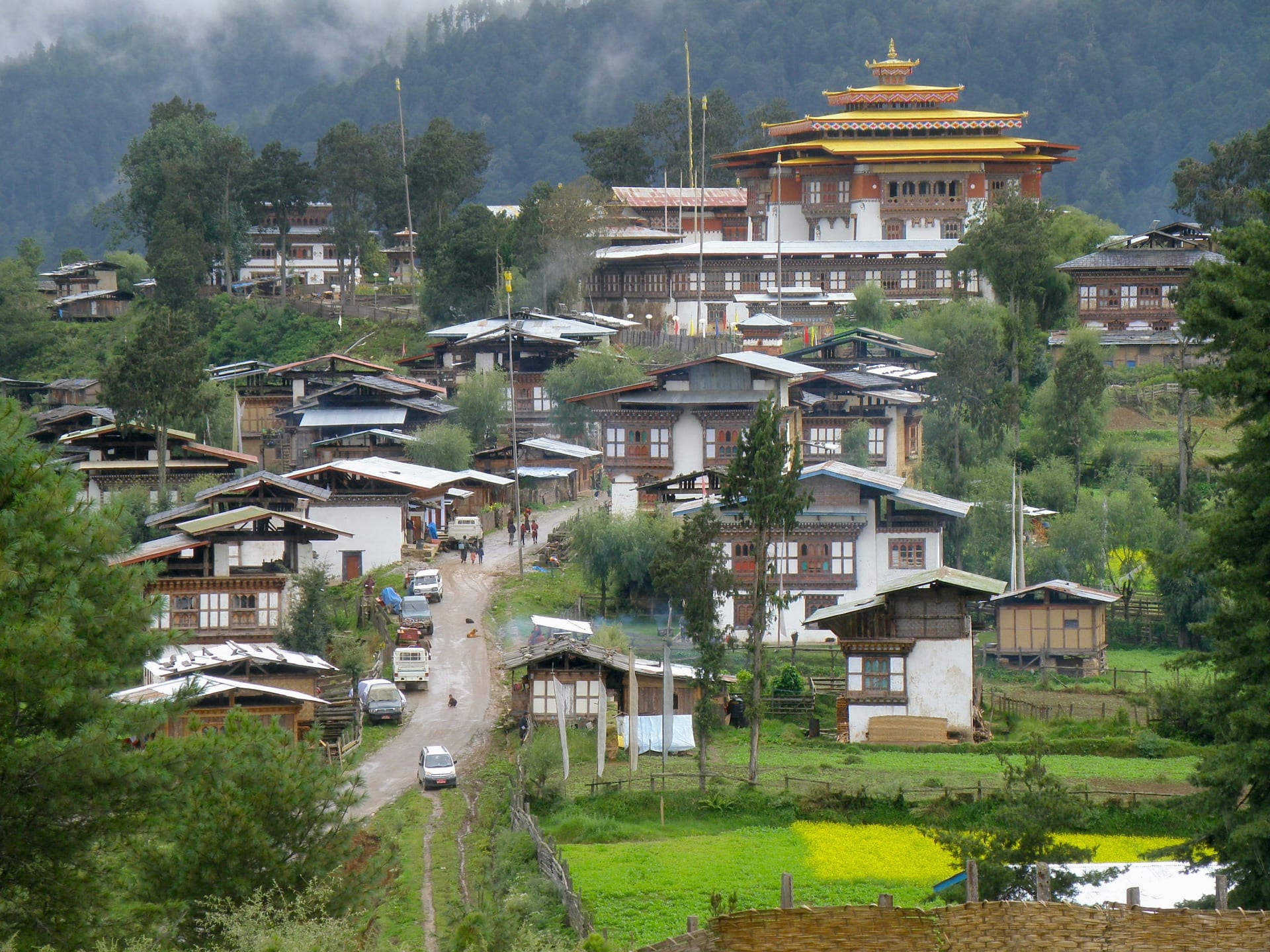
Built in 1667, this impressive dzong sits on a ridge overlooking the Chokhor valley. According to legend, a white bird rose into the sky and landed where the dzong now stands—interpreted as an auspicious sign.
What to Expect:
- Largest dzong in Bumthang region
- Beautiful location with panoramic valley views
- Traditional Bhutanese architecture
- Administrative and monastic center
Mebar Tsho (Burning Lake)
This sacred site is located about 30 minutes from Jakar. Despite its name, it’s not actually a lake but a deep pool in the Tang Chhu river. This is where Pema Lingpa discovered several hidden treasures (termas) in the 15th century.
According to legend, he dove into the water with a burning butter lamp and emerged with a sacred treasure and the lamp still burning.
Exploring the Four Valleys
Chokhor Valley
The main valley and home to Jakar town. Most visitors stay here as it has the most accommodation options.
What to See: Jakar Dzong, Jambay and Kurje Lhakhangs, Tamshing Lhakhang, Swiss Farm (try their delicious cheese, apple juice, and wine)
Tang Valley
The most remote of the four valleys. Tang offers pristine landscapes and authentic rural Bhutanese life.
Highlights: Mebar Tsho (Burning Lake), Ugyen Choling Palace (museum), traditional villages and farmhouses, beautiful hiking trails
Ura Valley
The highest of the four valleys. Ura features traditional villages clustered around a central temple.
Why Visit: Beautiful traditional architecture, Ura Temple with ancient paintings, sheep farming community, stunning mountain vistas
Chhume Valley
Known for its weaving tradition. This valley produces some of Bhutan’s finest textiles, particularly the distinctive Yathra woolen fabric.
What to Do: Visit weaving centers, buy authentic Yathra textiles, watch weavers at work, support local artisans
Cultural Experiences in Bumthang
Yathra Weaving
Bumthang is famous for Yathra, a distinctive woolen textile with colorful geometric patterns traditionally made from sheep wool dyed with natural colors.
Where to Buy: Chhume valley weaving centers, shops in Jakar town, directly from weavers in villages
Farmhouse Stay
Experience authentic Bhutanese hospitality in a traditional farmhouse. Bumthang families have been welcoming visitors for generations.
What to Expect: Traditional Bhutanese hospitality, home-cooked meals featuring local cuisine, introduction to rural Bhutanese life, try ara (local spirit) and suja (butter tea)
Cheese Tasting at Swiss Farm
The Swiss Farm produces excellent cheese, apple juice, and wine. Founded by a Swiss man who settled in Bhutan decades ago, it’s a unique cultural fusion.
Best Time to Visit Bumthang
| Season | Weather | Experience |
|---|---|---|
| Spring | 10-20°C, rhododendrons blooming | Ideal for hiking, festivals |
| Summer | Monsoon season, regular rainfall | Lush green, fewer tourists |
| Autumn | Clear skies, comfortable temperatures | Harvest season, peak tourist season |
| Winter | Cold days, freezing nights | Snow-capped peaks, fewest crowds |
Sample 3-Day Bumthang Itinerary
Day 1: Sacred Temples
Morning: Arrive in Jakar, check-in
Afternoon: Visit Jambay Lhakhang and Kurje Lhakhang
Evening: Explore Jakar town and visit Jakar Dzong
Day 2: Spiritual Heritage
Morning: Tamshing Lhakhang and Kencho Sum
Midday: Lunch at Swiss Farm
Afternoon: Visit Mebar Tsho (Burning Lake)
Evening: Traditional hot stone bath at farmhouse
Day 3: Valley Exploration
Morning: Drive to Tang or Ura valley
Midday: Picnic with mountain views
Afternoon: Visit weaving centers in Chhume
Evening: Departure or continue to eastern Bhutan
Spiritual Significance
Bumthang’s spiritual importance cannot be overstated. This is where Buddhism truly established itself in Bhutan. Guru Rinpoche’s 8th-century visit laid the foundation. Later, Pema Lingpa’s treasure discoveries reinforced the region’s sacred status.
Many Bhutanese people make pilgrimages to Bumthang at important times in their lives. The temples here are not just tourist attractions—they’re living, breathing sacred sites where daily rituals continue as they have for centuries.
“In the sacred valleys of Bumthang, every stone and every prayer flag tells a story of devotion that has continued for over a thousand years. Some blessings are woven not just into fabric, but into the very earth itself.” — Bhutanese Proverb
Ready to explore Bhutan’s spiritual heartland? Browse our tours or contact us to plan your Bumthang adventure.