

Festivals
Kurjey Tshechu: The Imprint of the Lotus-Born
The story of Kurjey Tshechu at Kurjey Lhakhang in Bumthang — Sindhu Raja's illness, Guru Rinpoche's body imprint in rock, the subjugation of Shelging Karpo, and the June festival that still honors that cave.
The story of Kurjey Tshechu at Kurjey Lhakhang in Bumthang — Sindhu Raja's illness, Guru Rinpoche's body imprint in rock, the subjugation of Shelging Karpo, and the June festival that still honors that cave.
In this story
A festival stay is about USD 1,100 per person. Ten private days for two is about USD 2,600–2,700 per person. The fee is included.
Kurjey Tshechu: The Imprint of the Lotus-Born
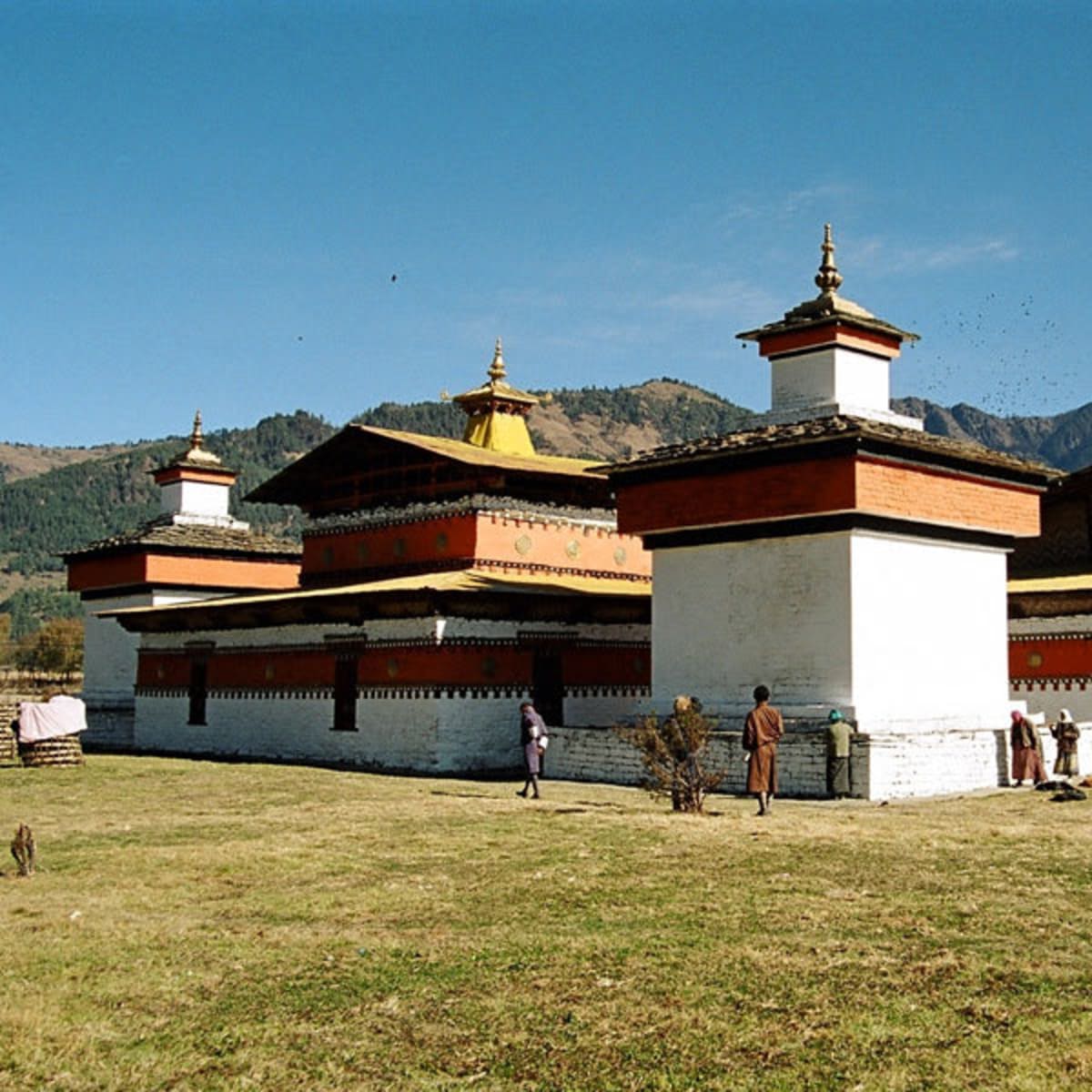
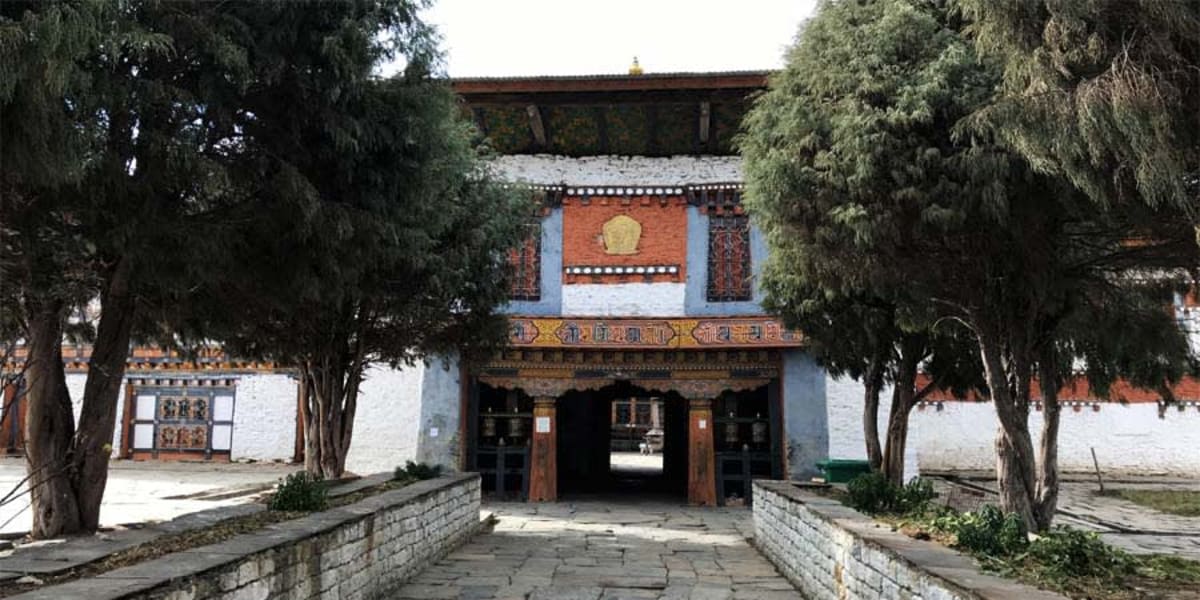
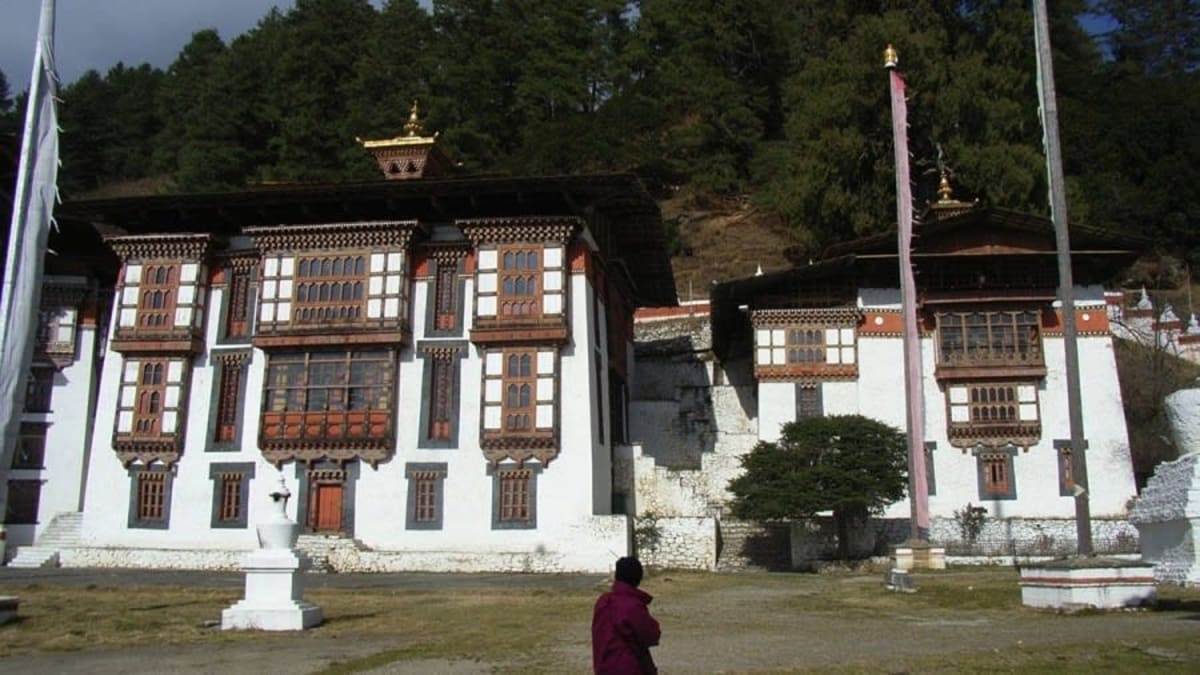
Before the sun clears the ridge above the Chokhor valley, the cypresses around Kurjey Lhakhang are already dripping. Mist hangs in the branches the way incense hangs in a shrine room — not still, exactly, but reluctant to leave. A monk in maroon crosses the courtyard with a tray of butter lamps, their flames bending in the draft. Behind him the oldest temple in the complex is a dark mouth in white plaster. Inside that mouth, if you know where to look when the lamps are lit, the rock itself remembers a body.
Kurjey means body imprint. The name is not poetry. It is a description. In the eighth century a man sat in a cave in this hillside until the stone took his shape, and the stone has not given it back. On festival mornings in June the courtyard fills, and the imprint is no longer a quiet fact for pilgrims who come one or two at a time. It becomes the reason a whole valley puts on silk.
The king who was emptying
The story the old people of Bumthang tell does not begin with a saint. It begins with a king who was dying in a way no physician could name. Sindhu Raja — Sendha Gyab in the local telling — ruled this valley when it was not yet a chapter in a guidebook. He had quarreled with Nawoche, a king of the southern lands. More dangerously, he had offended Shelging Karpo, a local deity who could take the form of a white bird, a snow lion, a glare of light on a cliff. Shelging Karpo stole the king’s life-force, his sog, the way a thief takes a jewel from a locked box. The king grew pale. The barley failed. The valley felt the theft even if it could not name the thief.
Messengers went out. Some versions send them to Nepal, some toward the Indian plains. They were looking for a master who could deal with gods that were not yet Buddhist, which is to say gods that had not yet been asked to protect anything but themselves. The master who came was Padmasambhava, Guru Rinpoche, the Lotus-Born, already famous for binding the spirits of Tibet without destroying them — for turning enemies of the Dharma into its guardians.
He did not arrive as a courtier. He arrived as a physician of a different order. He asked for a cave. He asked for time. On this hillside, in the rock that would later be walled into the first of Kurjey’s three temples, he sat. The meditation was not a retreat from the problem. It was the method. Wrathful compassion, in the Vajrayana, looks like battle only if you have never seen what ordinary battle does. Guru Rinpoche did not come to kill Shelging Karpo. He came to recover what had been stolen and to give the deity a new job.
The stories of the subjugation are the stories children in Jakar still hear: the master taking the form of a garuda, the white deity fleeing into a cliff, the life-force returned to the king like a bird coming back to the hand. When Sindhu Raja rose from his bed, the valley rose with him. The king took refuge in the Buddha, the Dharma, and the Sangha. The local gods, including Shelging Karpo, were bound by oath to protect the teachings they had tried to starve. Buddhism in Bumthang does not begin with a sermon in a hall. It begins with a healing, a binding, and a cave.
And the cave kept the shape of the man who sat in it. That is the fact pilgrims come for. You may believe the legend as history or as a map of the inner life — a king emptied by his own conflicts, a force of pride and territorial rage brought into the service of something larger. Either way, the rock is there. Either way, in June, the courtyard fills to honor it.
Three temples, one hillside
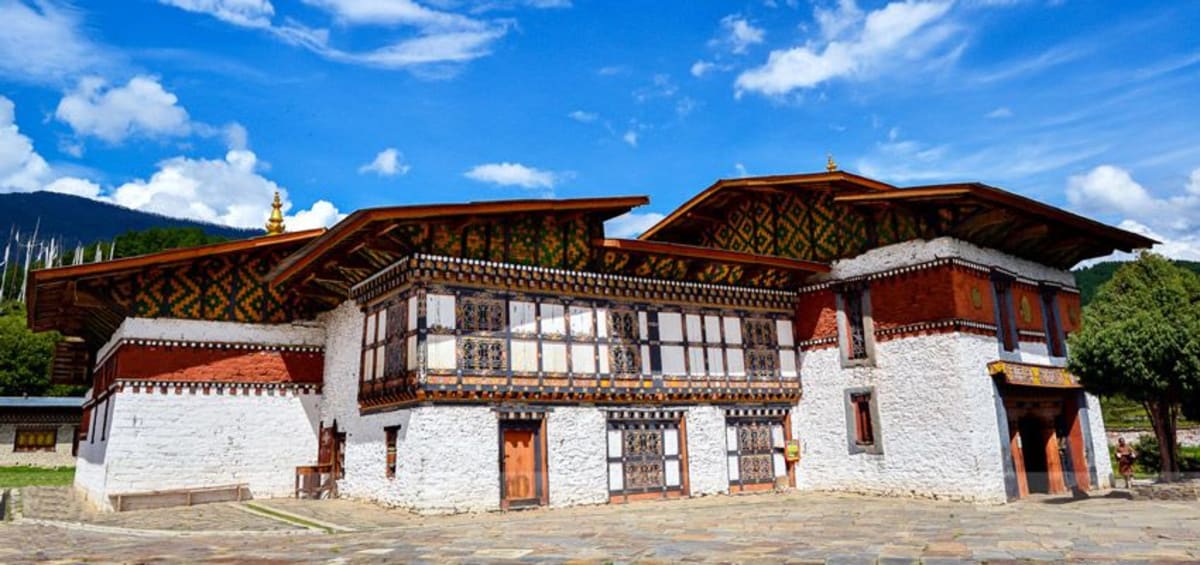
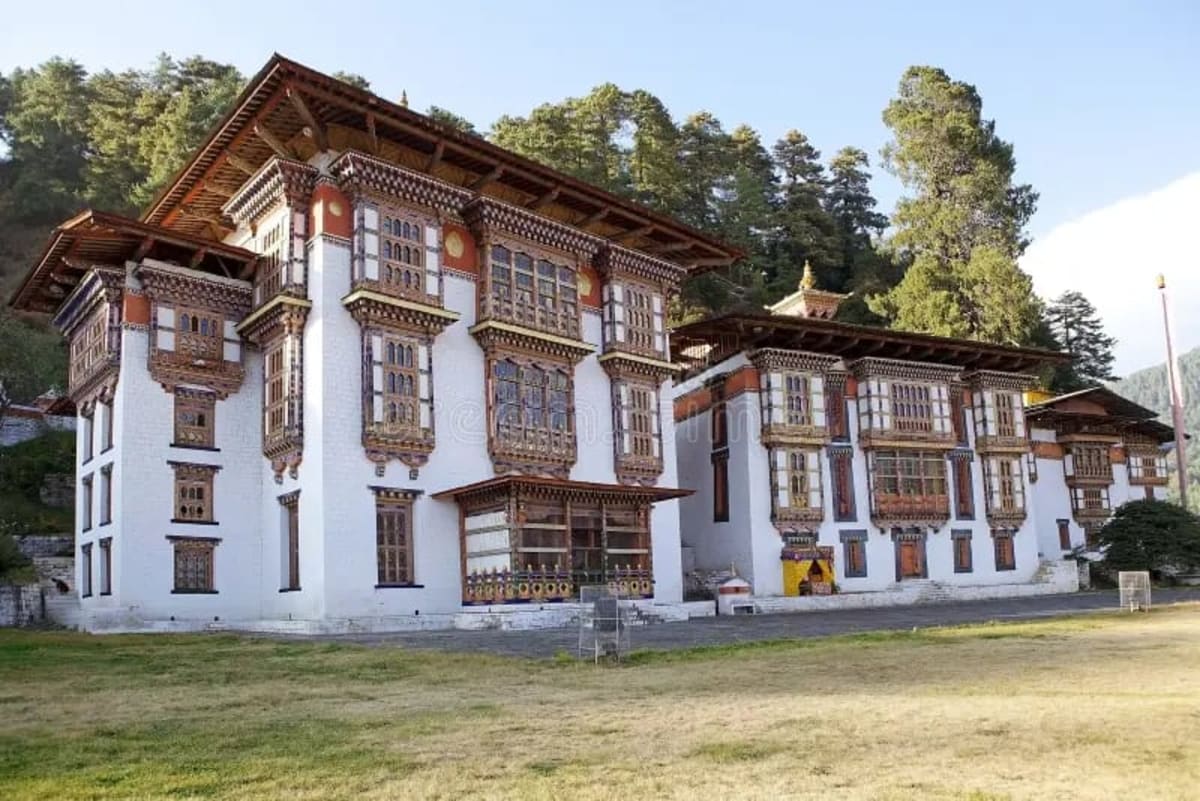
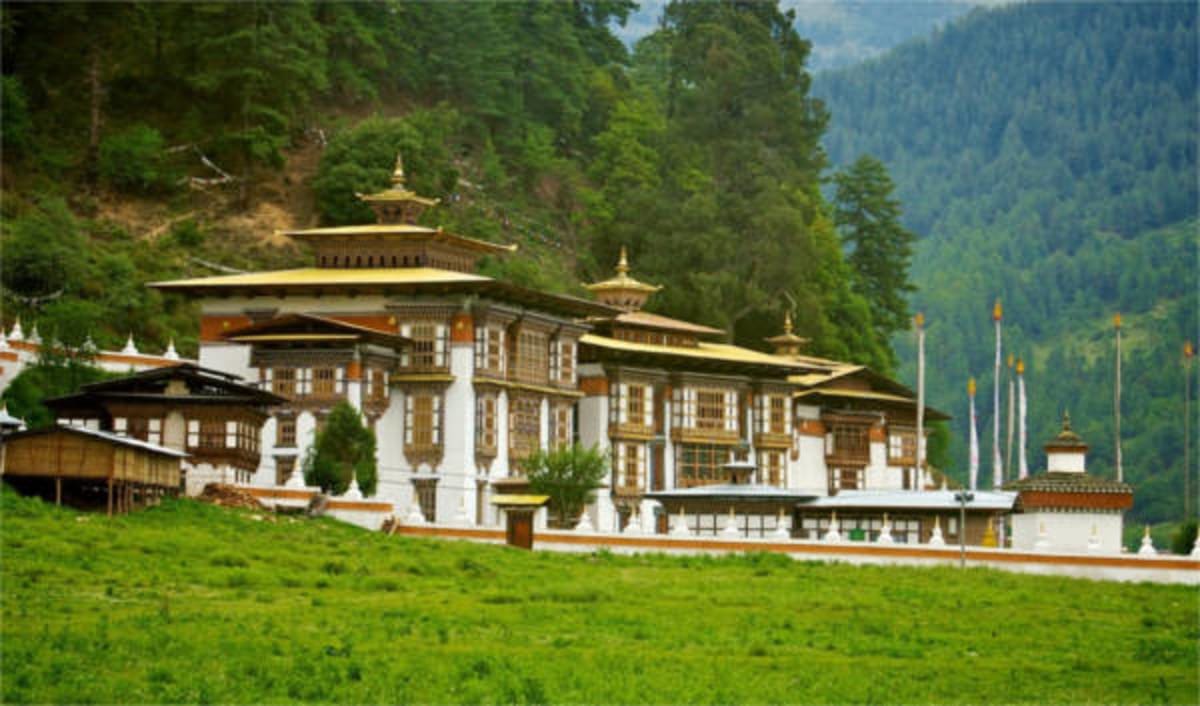
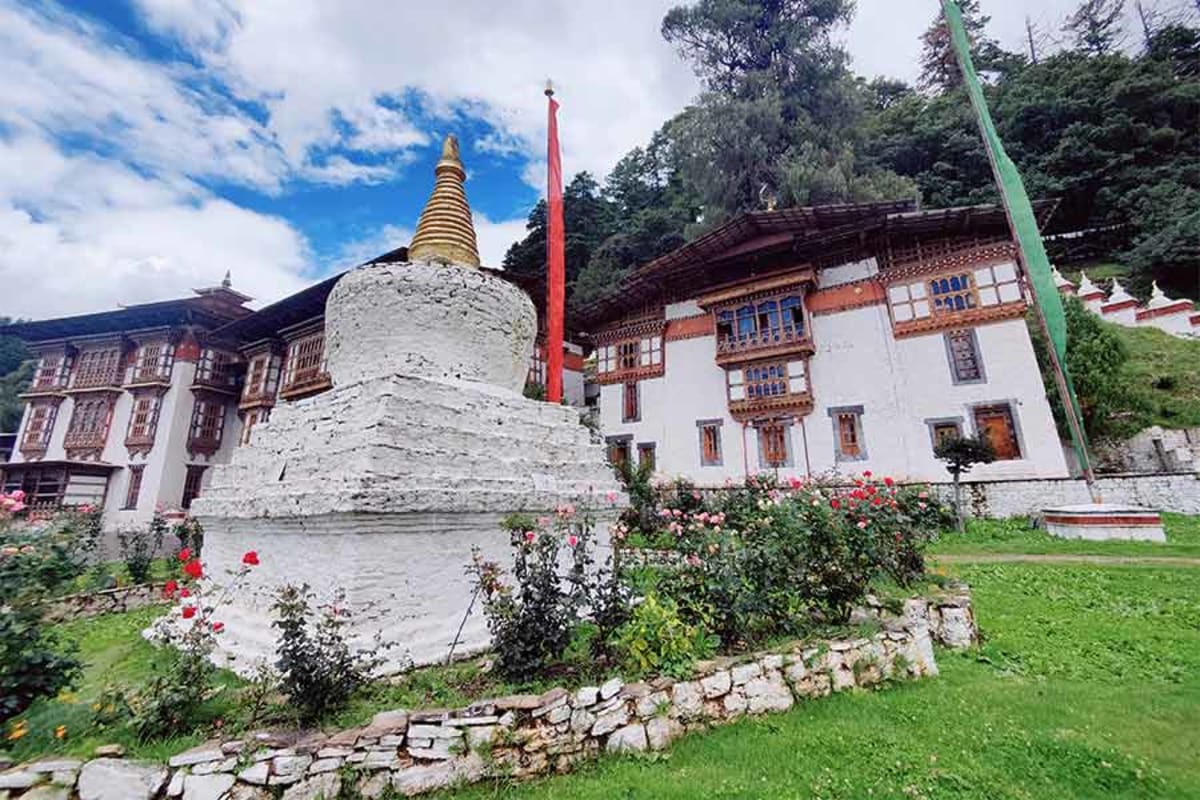
Kurjey is not a single building. It is a conversation across centuries. The oldest temple was raised around the imprint, a shell of devotion built so that the cave would not be only weather and stone. The middle temple came much later, in 1900, under the first King of Bhutan, when the monarchy itself traced blood and blessing back through these valleys. The newest, from 1990, was offered by the Queen Mother Ashi Kesang Choden Wangchuck, whose family line runs through Pema Lingpa to this same sacred geography. To walk from one shrine to the next is to walk through the layers of why Bumthang is called the spiritual heart of the country: Indian master, Tibetan king, Bhutanese treasure revealer, Bhutanese throne, all of them touching the same rock.
Cypresses stand around the complex like a second wall. Prayer wheels click along the kora path. From the upper terrace you look down on the Chamkhar Chu and the fields that feed Jakar, and across the water, on a clear day, you can see Tamshing, Pema Lingpa’s own temple, as if the two banks of the river were speaking. I have brought guests here at dawn when there was no festival at all, only a few old women circumambulating, and the place is already enough. During Kurjey Tshechu it becomes a different instrument. The same stones, a louder music.
On festival days the three temples do not compete. They take turns being the center of gravity. Butter lamps multiply in the oldest shrine until the imprint seems to float in a small lake of fire. Outside, boots scuff the kora path into a paler ring. A vendor from Jakar town sets out dried cheese and warm buns on a cloth, and the smell of those buns, ordinary and yeasted, sits beside the smell of incense without either one winning. This is how sacredness actually lives in Bumthang: not sealed away from lunch, but sharing a courtyard with it.
June, silk, and the old steps
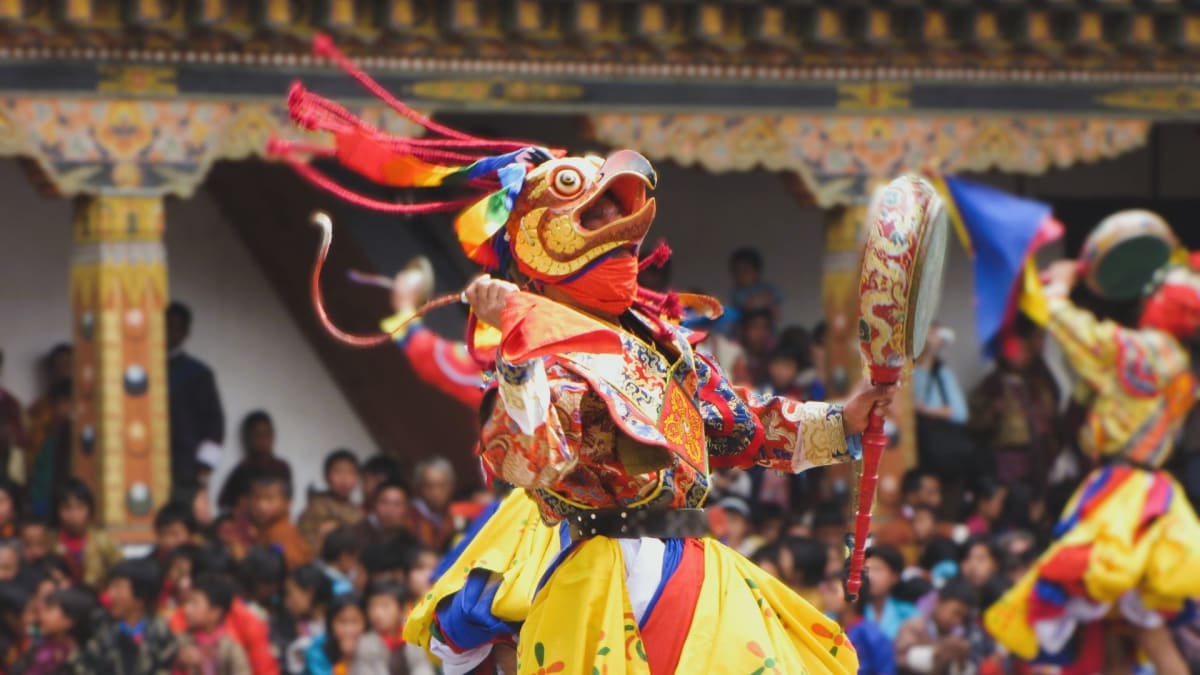
The tshechu does not try to outdo Paro’s crowds or Thimphu’s scale. It does not need to. The courtyard is intimate enough that you can see the sweat at a dancer’s temple, the frayed edge of a mask that has been repaired rather than replaced. Cham here is offered to the imprint. Every turn of a black-hat dancer, every skeleton that leaps in the Durdag, every manifestation of the Guru, is a way of saying to the rock: we remember who sat here.
I watch the lay people as much as the dancers. A farmer from the upper village has put on his best gho, the one with the pattern his wife wove, and he stands with his hands folded not in a tourist’s hush but in the ordinary concentration of someone who has taken a day from the fields because the day is not ordinary. Children imitate the atsaras until an auntie hisses them back. Butter tea makes the rounds in thermoses. The June light in Bumthang is a clean, high light; the monsoon has not yet closed the sky, and the green of the valley is almost too much, a green that makes the white of the temples look like a statement.
When the Guru Tshengye is danced — the eight manifestations of Padmasambhava — I always think of the cave. Guru Tsokye Dorje, born from the lotus. Guru Dorje Drolo, the fierce one who subdues. The masks are not costumes in the theater sense. The tradition holds that the dancer, if the practice is true, becomes a vessel. On this hillside that teaching has a physical address. The man who could take those forms left his ordinary human outline in stone, which is a paradox the festival does not try to resolve. It only keeps returning to it, year after year, the way a river returns to the same bend.
After the last dance the crowd does not rush for cars. There are not that many cars. People walk the kora again. They offer a lamp. Some go into the oldest temple and sit in the dim until their eyes find the imprint, and then they sit a little longer. I have seen visitors who came for photographs put the camera away without being asked. The rock does that. It is not dramatic. It is simply older than the wish to capture it.
Kurjey Tshechu is held in June, on dates that shift with the Bhutanese lunar calendar, in the courtyard of the complex a short drive from Jakar. You attend as any pilgrim does: shoulders and knees covered, clockwise around the temples, no photography where the lamas forbid it, and enough time — a morning at least, a full festival day if you can give it — to let the hillside work on you. Foreign travelers come with a licensed operator, because that is how Bhutan asks the world to arrive, and because a good guide will tell you the Sindhu Raja story not as a plaque on a wall but as a living argument about what this valley thinks power is for. The king was emptying. A master sat until the stone remembered him. A deity of white rage was given a new oath. Once a year the silk comes out, the drums start, and the imprint, which does not move, is treated as the most moving thing in Bumthang.
Send your dates
A festival stay is about USD 1,100 per person. Ten private days for two is about USD 2,600–2,700 per person. The fee is included.