

Festivals
Jambay Lhakhang Drup: The Night the Fire Walks
A narrative journey through Jambay Lhakhang Drup in Bumthang — Songtsen Gampo's seventh-century temple, Guru Rinpoche's consecration, the Mewang fire blessing, Ter Cham treasure dance, and Drametse Ngacham.
A narrative journey through Jambay Lhakhang Drup in Bumthang — Songtsen Gampo's seventh-century temple, Guru Rinpoche's consecration, the Mewang fire blessing, Ter Cham treasure dance, and Drametse Ngacham.
In this story
A festival stay is about USD 1,100 per person. Ten private days for two is about USD 2,600–2,700 per person. The fee is included.
Jambay Lhakhang Drup: The Night the Fire Walks
The first thing you smell is juniper. Then butter, then the dry snap of barley straw catching. In the courtyard of Jambay Lhakhang the dark is not empty. It is packed with people in silk and wool, their breath white in the Bumthang cold, their faces turned toward a gate of stacked wood that has not yet been lit. A child presses against her grandmother’s kira. A monk’s cymbal rings once, a thin bright sound, and then the drums begin — not the polite drums of a daytime tshechu, but something older, something that seems to come up through the packed earth of the courtyard itself.
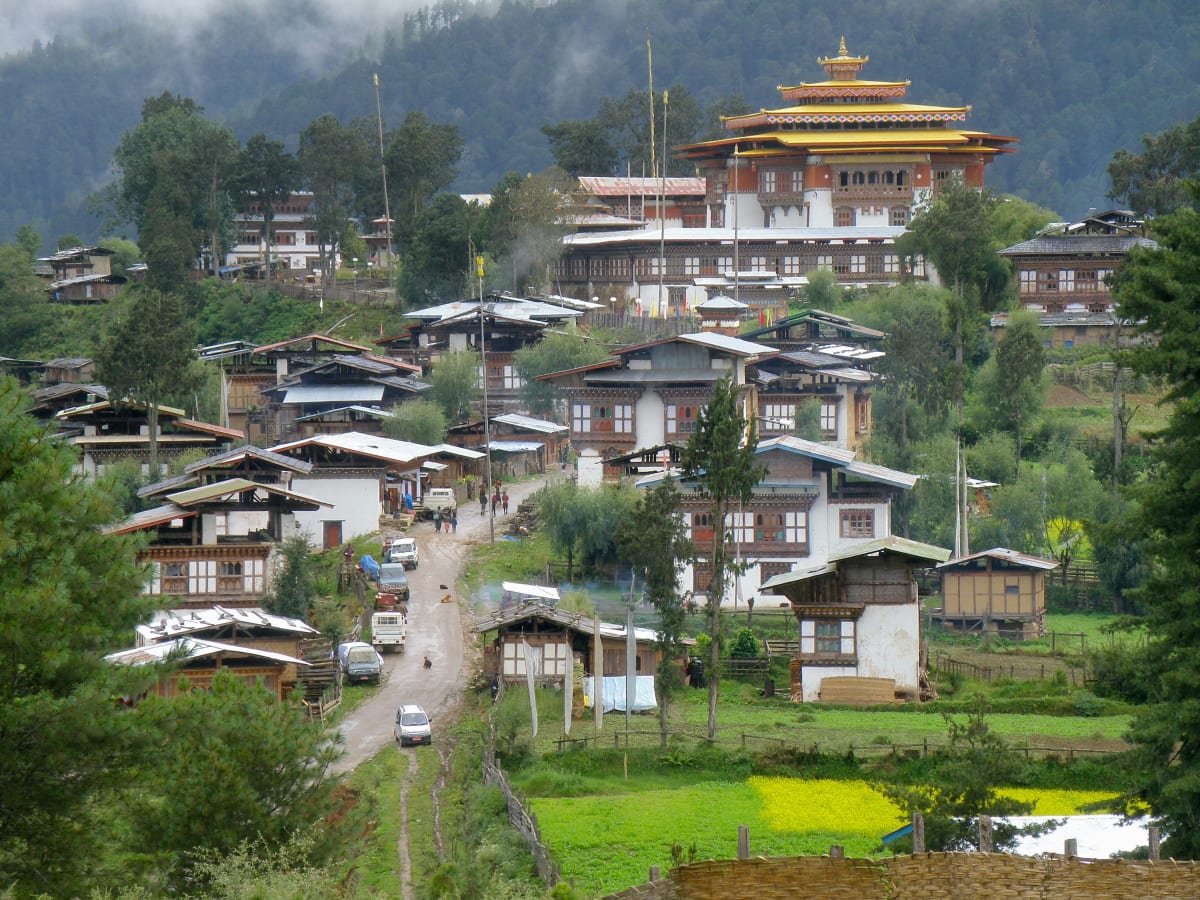
I have stood in this courtyard more nights than I can count. Every October, or early November if the lunar calendar delays its kindness, the Chokhor valley gathers here as it has for centuries. Tourists who know only Paro and Thimphu think they have seen a Bhutanese festival. They have seen a magnificent one. They have not yet stood in a seventh-century temple yard while a fire is built into a doorway and the whole valley waits to walk through it.
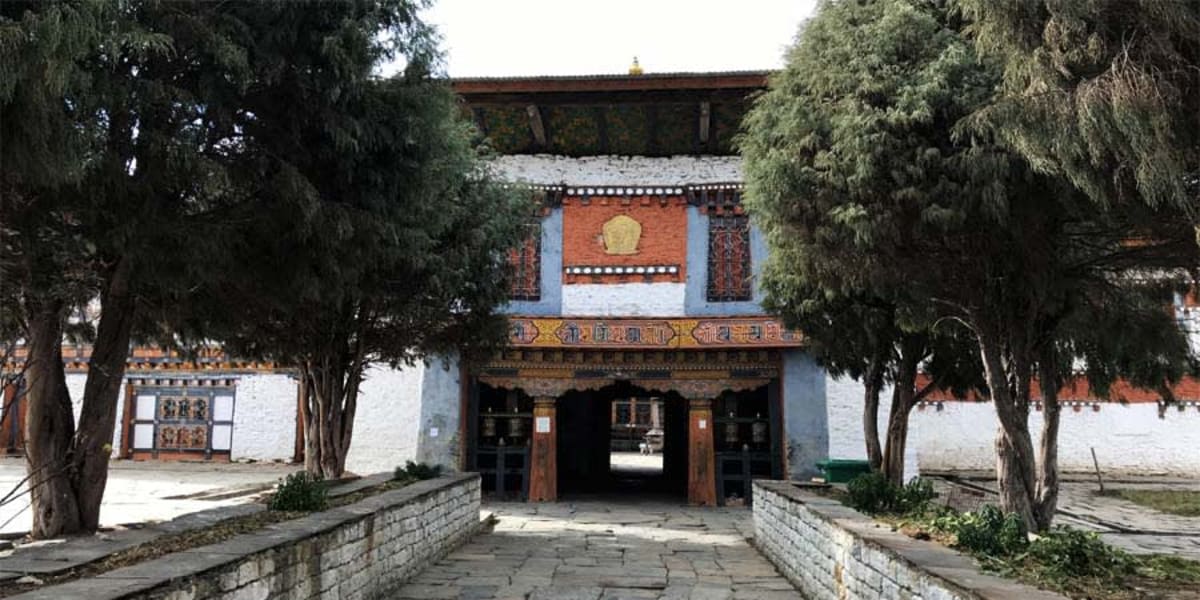
A temple pinned to the earth
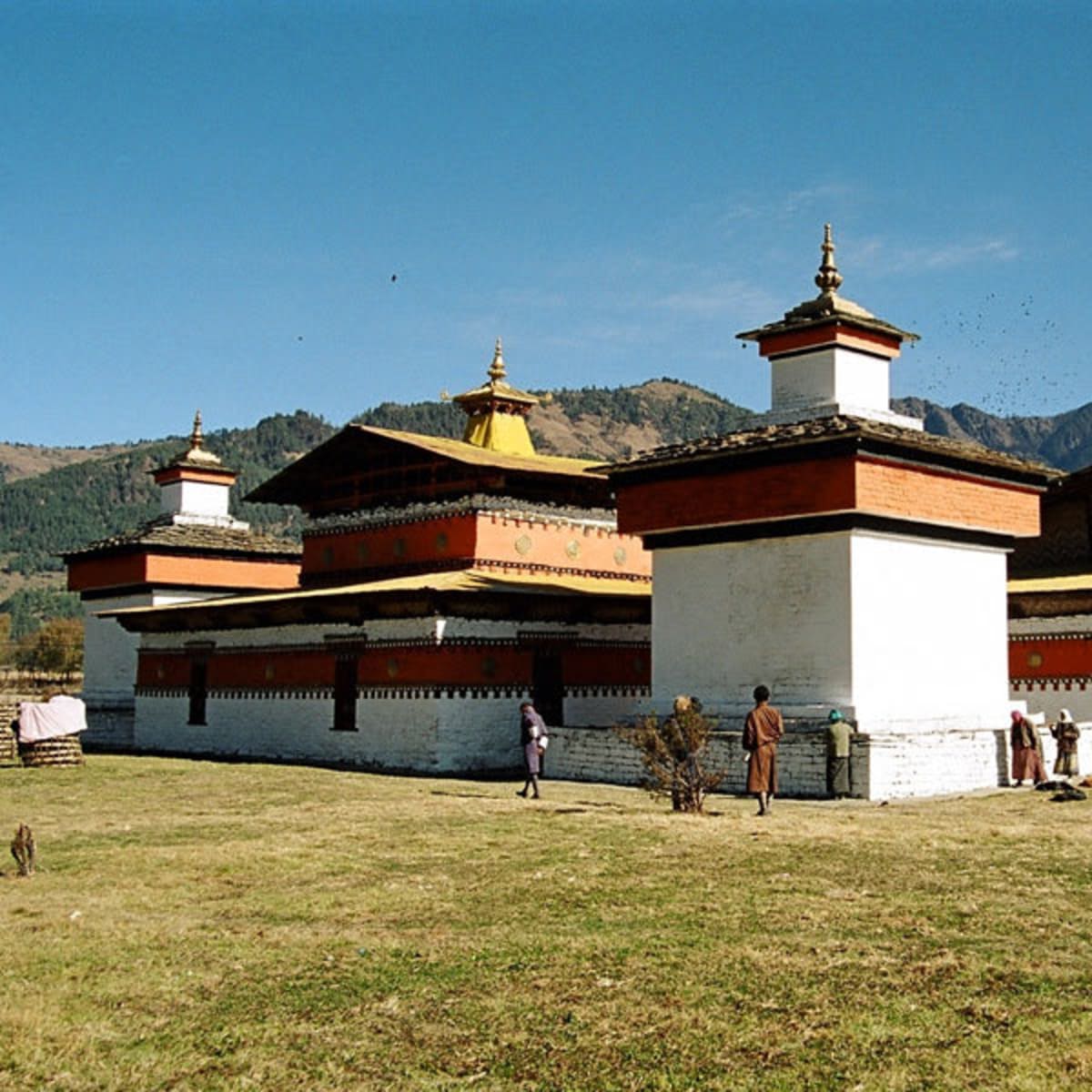
The story of this place begins not with fire but with a demoness. In the seventh century, King Songtsen Gampo of Tibet looked across the Himalaya and saw an obstruction: a vast supine ogress whose body lay over the land, blocking the spread of the Dharma. Geomancy, in those days, was a kind of medicine. The king ordered one hundred and eight temples built in a single day, each one a pin driven into a joint or a limb of the demoness, so that she might be held still and the teachings could travel.
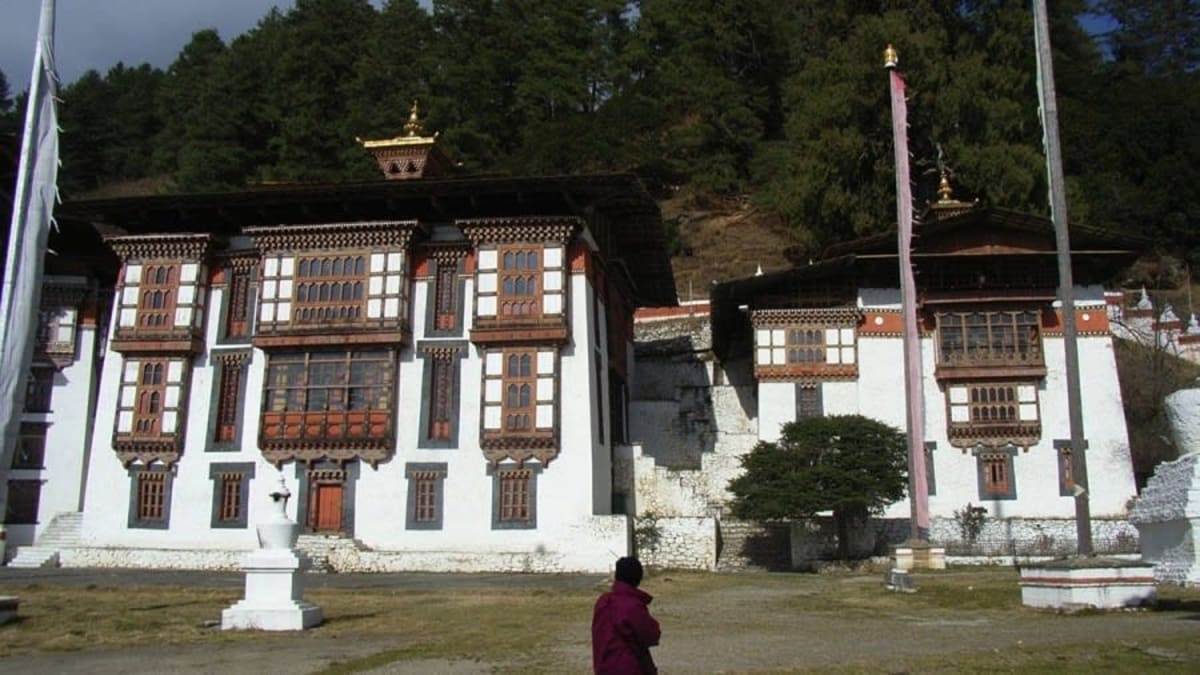
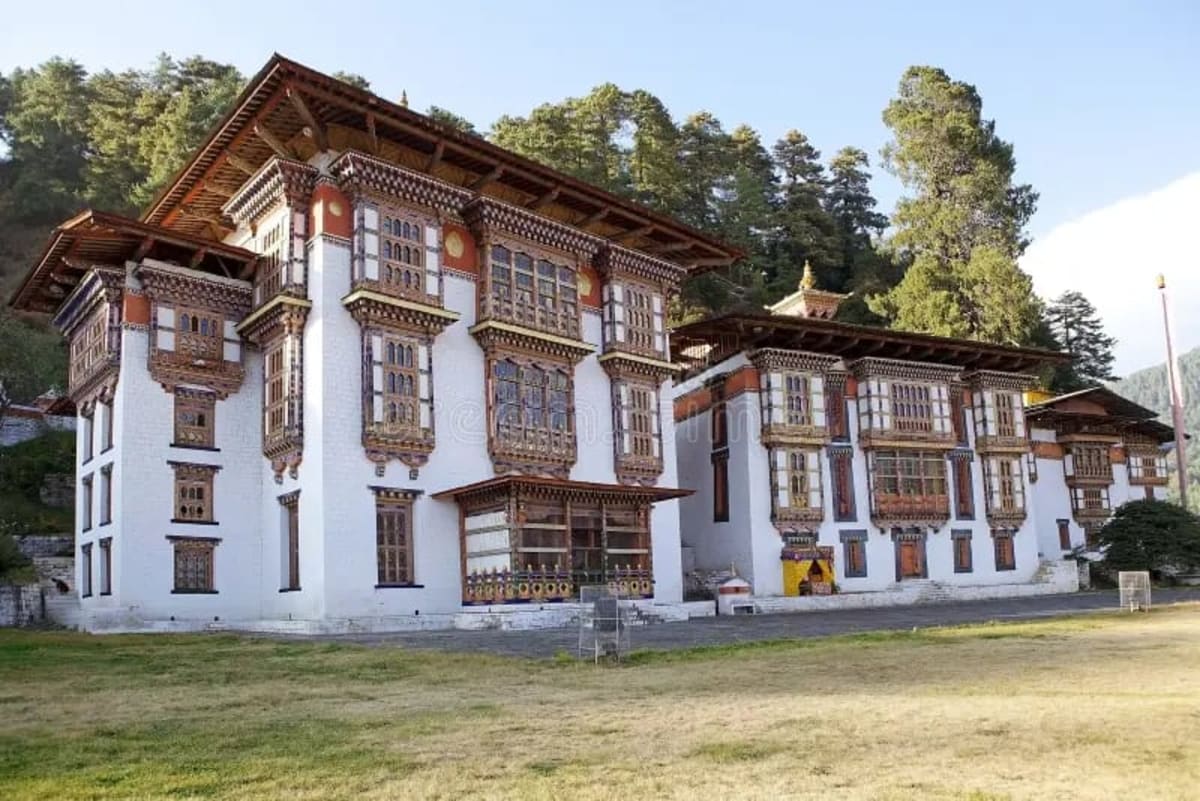
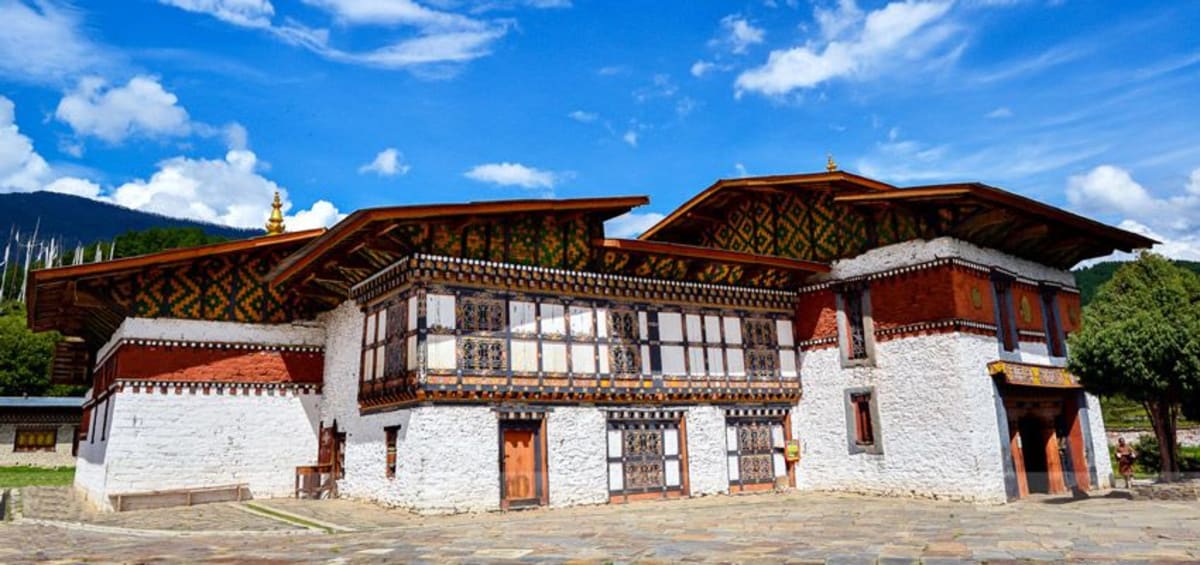
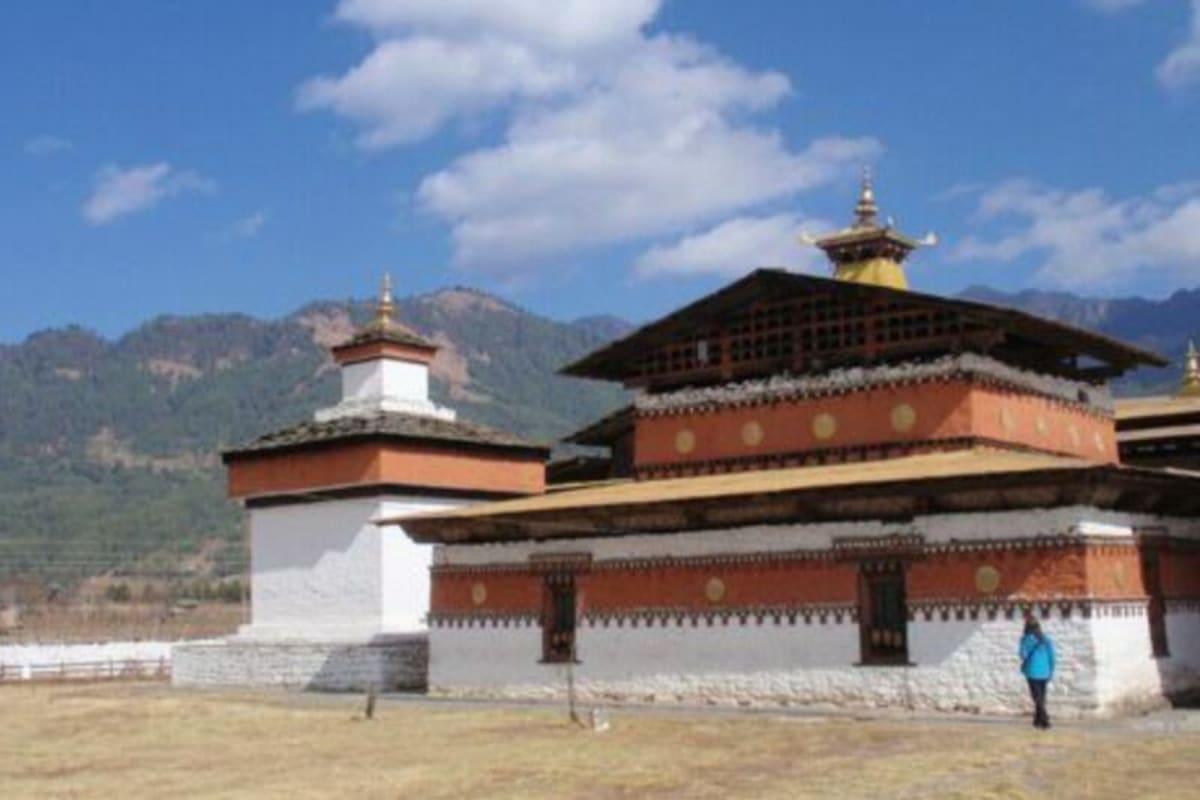
Jambay Lhakhang is one of those pins. Kyichu Lhakhang in Paro is the other that remains standing on Bhutanese soil. Walk around the outer wall of Jambay and you are circling a building that was already old when Guru Rinpoche arrived in the eighth century to consecrate it, already a place of power when the rest of what we now call Bhutan was still a scatter of valleys and local gods. The walls are thick. The windows are small. The inner shrine holds a statue of Jowo Jampa, the future Buddha Maitreya, whose gaze has received the same butter lamps for more than a thousand years.
I like to bring guests here in the afternoon, before the festival crowds thicken, when a few old men sit in the sun turning prayer wheels and the only sound is the river somewhere below the fields. You can still feel the pin. The valley is open and golden in autumn, buckwheat rusting toward harvest, but the temple sits with a peculiar weight, as if the ground under it is denser than the ground around it. Songtsen Gampo did not build a pretty chapel. He built a lock.
Guru Rinpoche, Padmasambhava, the Lotus-Born, came later and turned the lock into a blessing. He consecrated the temple, bound its local spirits, and left in the valley a current that would never quite go still. When Pema Lingpa, Bumthang’s own treasure revealer, recovered dances and teachings hidden for later ages, some of that current ran through Jambay Lhakhang. The festival you see now is not a performance invented for visitors. It is the annual opening of that lock.
Mewang: the fire that blesses
On the main night of the Drup the courtyard changes its physics. Wood is stacked into an arch, a gate you could walk through if you were willing to walk through fire. The Mewang is not a spectacle in the Western sense. It is a purification. The fire is blessed. The flames are not entertainment; they are the visible form of a ritual that burns obstacles, illness, and the dull film that gathers on a life.
When the gate is lit, the heat hits your face from twenty paces. Sparks climb into a sky already thick with stars — Bumthang at 2,600 meters has the kind of night that makes city people go quiet. The drums do not stop. Atsaras, the sacred clowns in red masks, shove and joke at the edges of the crowd, because even a fire blessing needs someone to keep fear from turning into stiffness. Then the first devotees go through.
I have watched farmers from Tang and Chumey, monks from the nearby shedra, a grandmother holding a child’s hand, a young man in a borrowed gho, all of them ducking under the burning lintel. Some run. Some walk as if they were entering a room they have entered every year of their lives, which is often true. The belief is simple and not simple: the fire takes what should not travel with you into the coming year. You come out the other side slightly smoked, slightly laughing, and — if you let it — lighter.
Visitors sometimes ask whether they may pass through. The answer depends on the year, the lamas, and the mood of the courtyard. What I tell people is this: do not treat the gate as a photograph. If you are invited, go with the same intention as the people around you. If you are not, stand close enough to feel the heat on your skin. That is already a kind of passage.
Between the runs through the gate there is a kind of hush that is not silence. You hear silk. You hear someone sucking air through their teeth at a spark that landed too close. You hear a monk’s chant riding over the drums without competing with them, as if the two sounds had agreed, centuries ago, on who would take the high line. I have stood so close that the hairs on my forearms tightened. I have also stood at the back with a guest who was afraid of fire and still, afterward, said the night had rearranged something she did not have a name for. That is the Mewang’s real work. It does not require you to be brave. It requires you to be present while other people are brave, and to notice what that does to a crowd.
The Mewang is why this festival cannot be swapped for another tshechu on a convenient date. Paro has its thongdrel at dawn. Thimphu has the scale of a capital. Jambay Lhakhang has this: a seventh-century courtyard, a burning door, and a valley that still believes fire can bless.
Dances that were hidden, then found
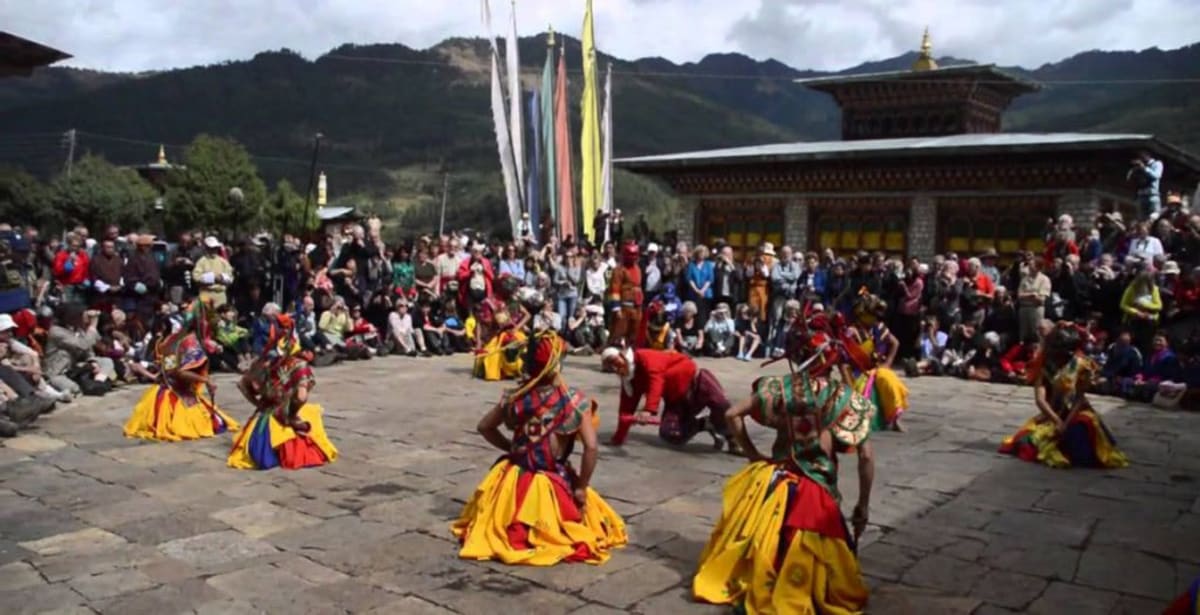
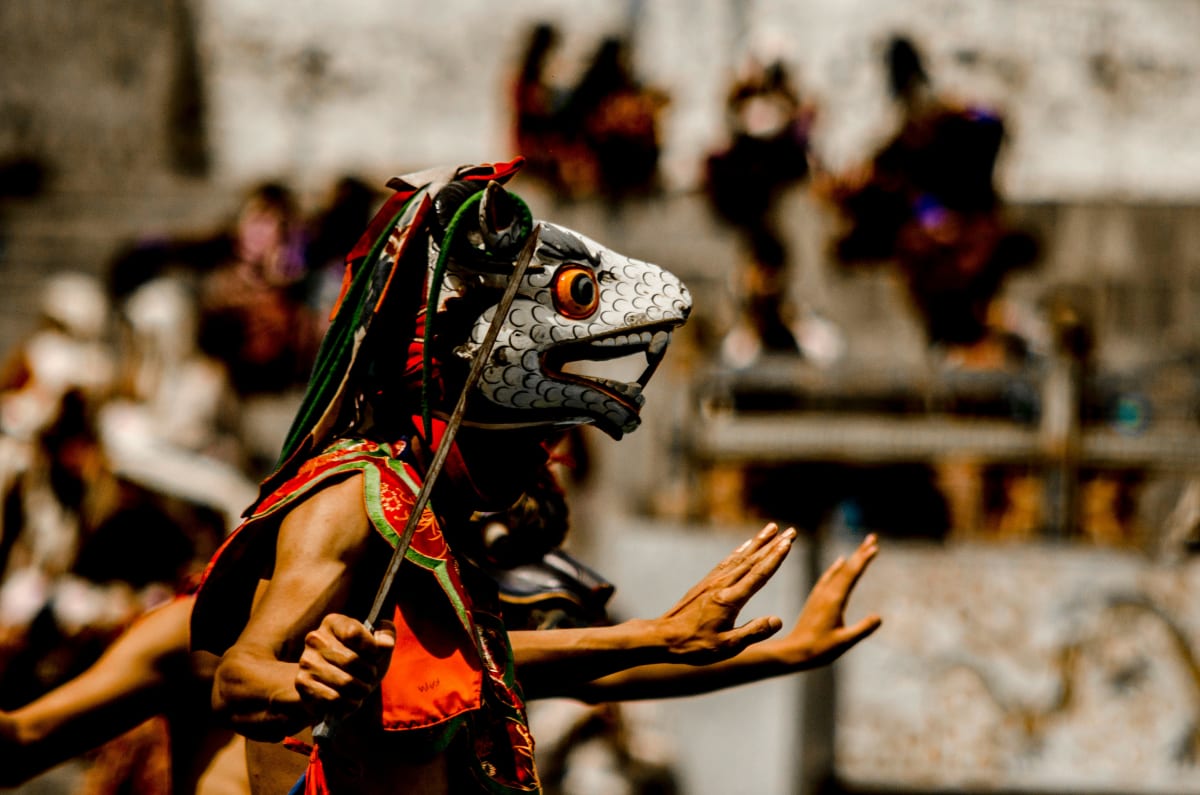
By day the courtyard fills with cham. Masks of wrathful deities, of skeletons, of animals that are not quite animals, turn in the old geometry of steps that monks and lay dancers have rehearsed for weeks. Silk brocade catches the high autumn sun. The smell of fried snacks from stalls along the wall mixes with incense. Children dart between the legs of adults. This is the social heart of the Drup — Bumthang meeting itself, families from the four valleys greeting cousins they have not seen since the last harvest.
Among the dances, Drametse Ngacham arrives with a different gravity. The drum dance of Drametse was born from a sixteenth-century vision, a lama’s dream in which celestial beings danced with drums, and the steps were brought back into the human world. UNESCO later named it an intangible heritage of humanity, which is a modern sentence for an old fact: when those yellow skirts turn and the drums speak in unison, something in the air changes. Even people who do not know the story feel the change. I have seen visitors weep without knowing why. The dancers are not performing a folk number. They are keeping a vision in circulation.
Then there is the dance that cannot be photographed, cannot be casually described, and cannot be moved to a convenient hour. Ter Cham, the treasure dance, belongs to the lineage of terma — teachings and practices hidden by Guru Rinpoche and his consorts to be revealed when the world would need them. Pema Lingpa, who pulled treasures from Mebar Tsho, the Burning Lake, not far from here, revealed this dance as well. It is performed at midnight, in the deep of the festival, by dancers whose costume is the mask and the teaching itself. The courtyard is colder then. The jokes of the atsaras fall away. What remains is a blessing that the tradition holds as especially potent: to witness it with a quiet mind is to receive something that cannot be bought and should not be streamed.
I will not tell you more than that. The dance has survived by remaining itself. If you come, you will understand why the night is the true architecture of this festival, why the days of cham are a long approach, and why Jambay Lhakhang Drup is spoken of in Bumthang with a different tone than other tshechus — not louder, exactly, but lower, like a fire that has burned down to coals.
When the last drum falls silent, the courtyard does not empty at once. People linger. Someone shares roasted rice from a cloth bag. The burned gate is a black rib against the stars. The temple, which has held a demoness in the earth for thirteen centuries, looks almost ordinary again — white walls, red band, a roof that has been repaired more times than anyone living can remember. You walk out toward the road and the cold comes back into your hands, and you realize you have been warm for hours without noticing.
The Drup follows the Bhutanese lunar calendar and falls in October or November, a handful of days in which the Mewang, the Drametse Ngacham, and the midnight Ter Cham are the pulse of the valley. Foreign visitors attend with a licensed Bhutanese operator; the courtyard is small, nights at this altitude bite, modest dress is not optional, and the most sacred sequences ask for silence rather than lenses. Come for the fire if you must choose one image to carry home. Stay through the hour after midnight if you want the image to change you. The pin that Songtsen Gampo drove into this ground is still in the ground. Once a year, Bumthang gathers around it, and the lock opens just wide enough to walk through.
Send your dates
A festival stay is about USD 1,100 per person. Ten private days for two is about USD 2,600–2,700 per person. The fee is included.