

Festivals
Nimalung Tshechu: Dawn Cloth in the Chumey Valley
A story of Nimalung Tshechu at Nimalung Dratshang in Bumthang's Chumey Valley — Pema Lingpa lineage, the unfurling of the thongdrel, and a June and July festival among yathra looms and pine.
A story of Nimalung Tshechu at Nimalung Dratshang in Bumthang's Chumey Valley — Pema Lingpa lineage, the unfurling of the thongdrel, and a June and July festival among yathra looms and pine.
In this story
A festival stay is about USD 1,100 per person. Ten private days for two is about USD 2,600–2,700 per person. The fee is included.
Nimalung Tshechu: Dawn Cloth in the Chumey Valley
They unfurl it before the sun has decided. In the last blue of night the courtyard of Nimalung Dratshang is a held breath: monks on the roof, ropes in their hands, a crowd that has walked up from the Chumey floor with lamps and thermoses and children half asleep on hips. Then the thongdrel begins to fall — not drop, fall, the way a cliff of silk can fall — and Guru Rinpoche’s face, large enough to bless a valley, comes down the monastery wall into the first light.
Thongdrel means liberation upon sight. I have watched people raise their hands toward the bottom edge as if the cloth were a shore. An old man from a house where yathra is still woven on a backstrap loom does not look at the cameras, because there are few cameras. He looks at the eyes of the painted Guru. For a few minutes the whole of Chumey is oriented to a single rectangle of color. Then the sun clears the eastern pine, the gold leaf flares, and someone in the crowd starts to cry in the practical way Bhutanese people cry at blessings — quietly, as if it were a private weather.
A valley that weaves and prays in the same houses
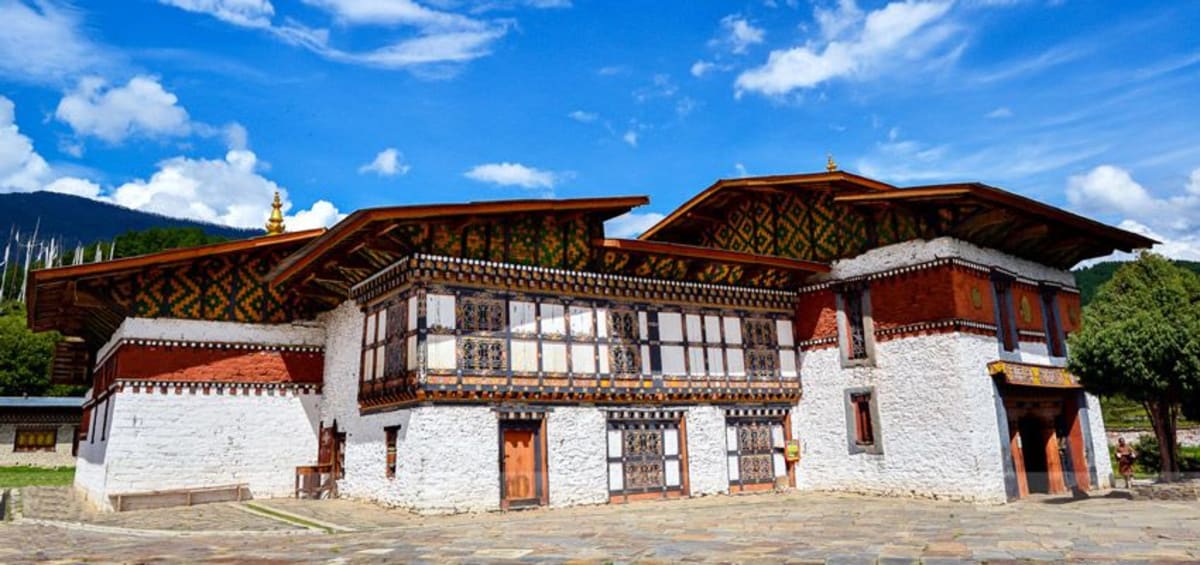
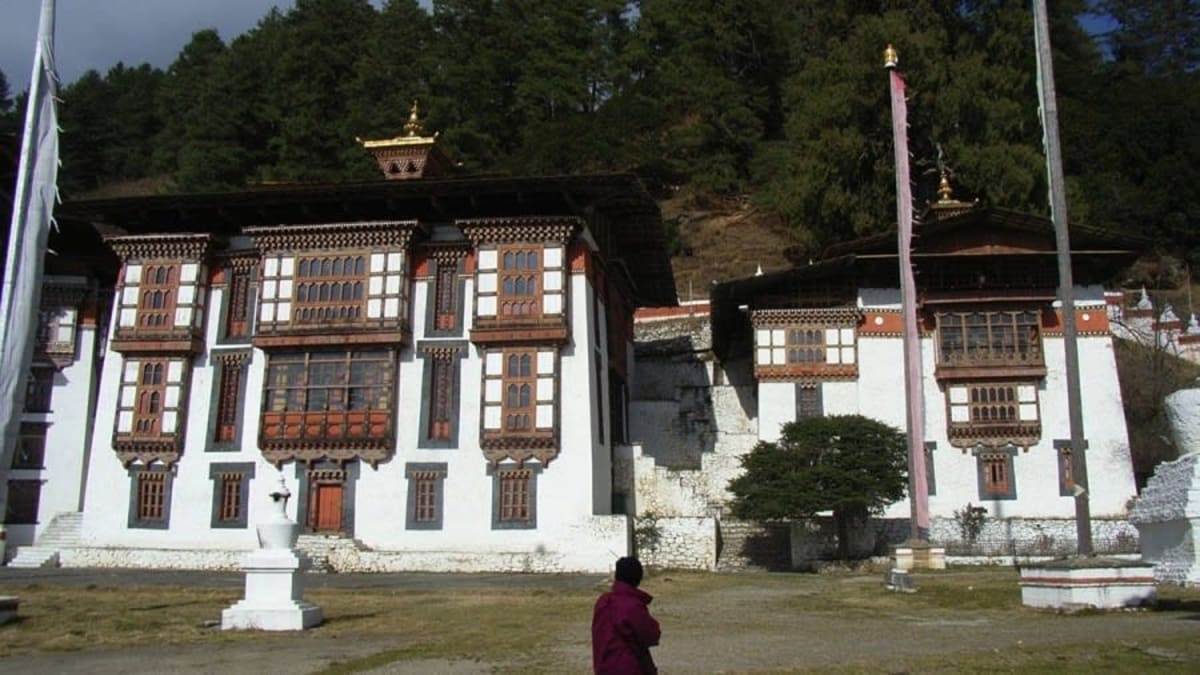
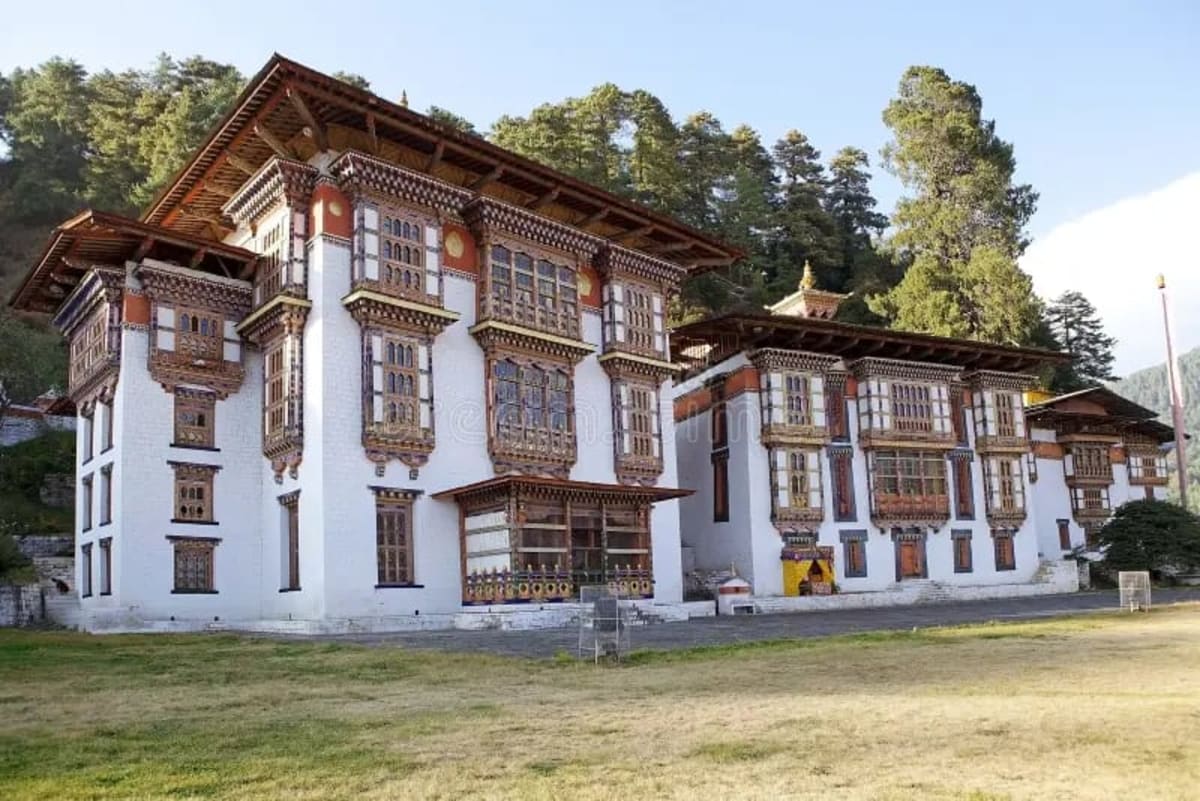
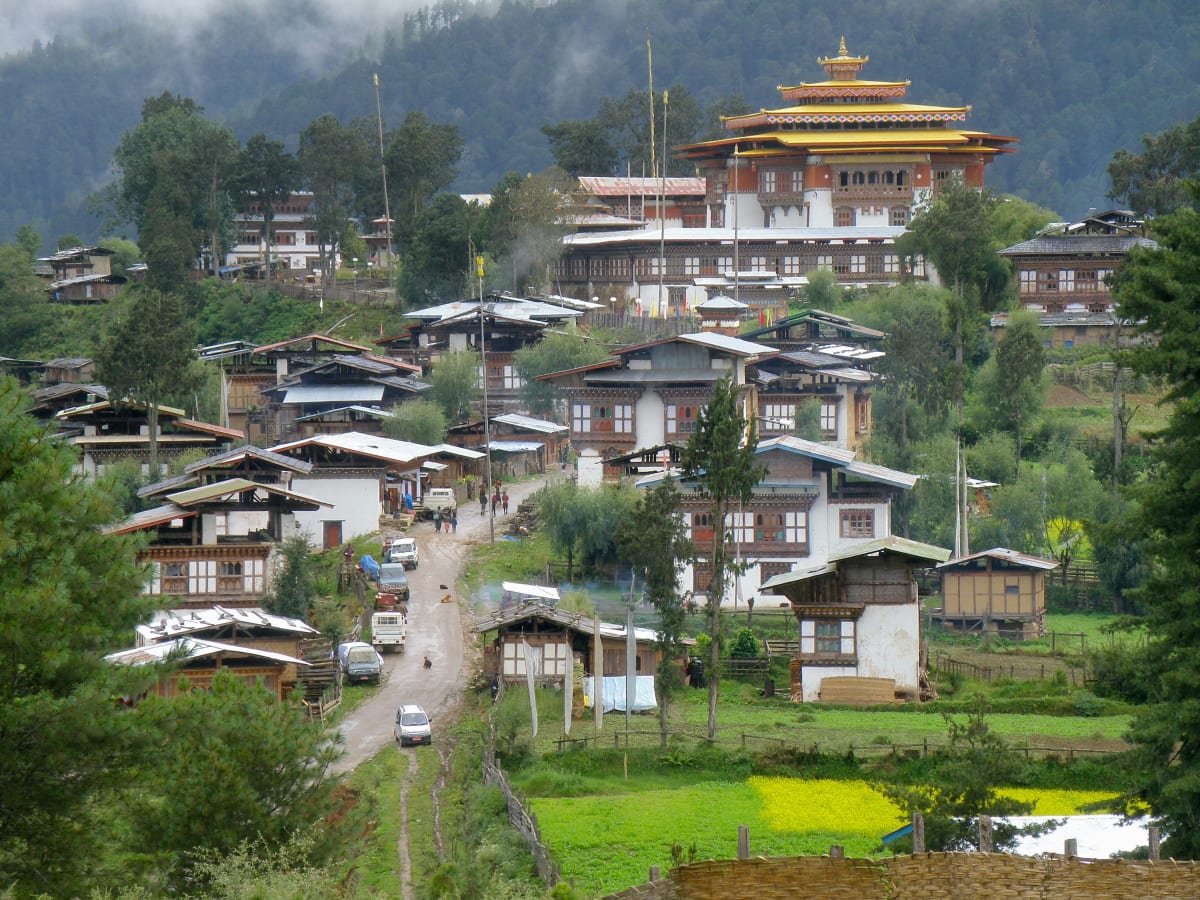
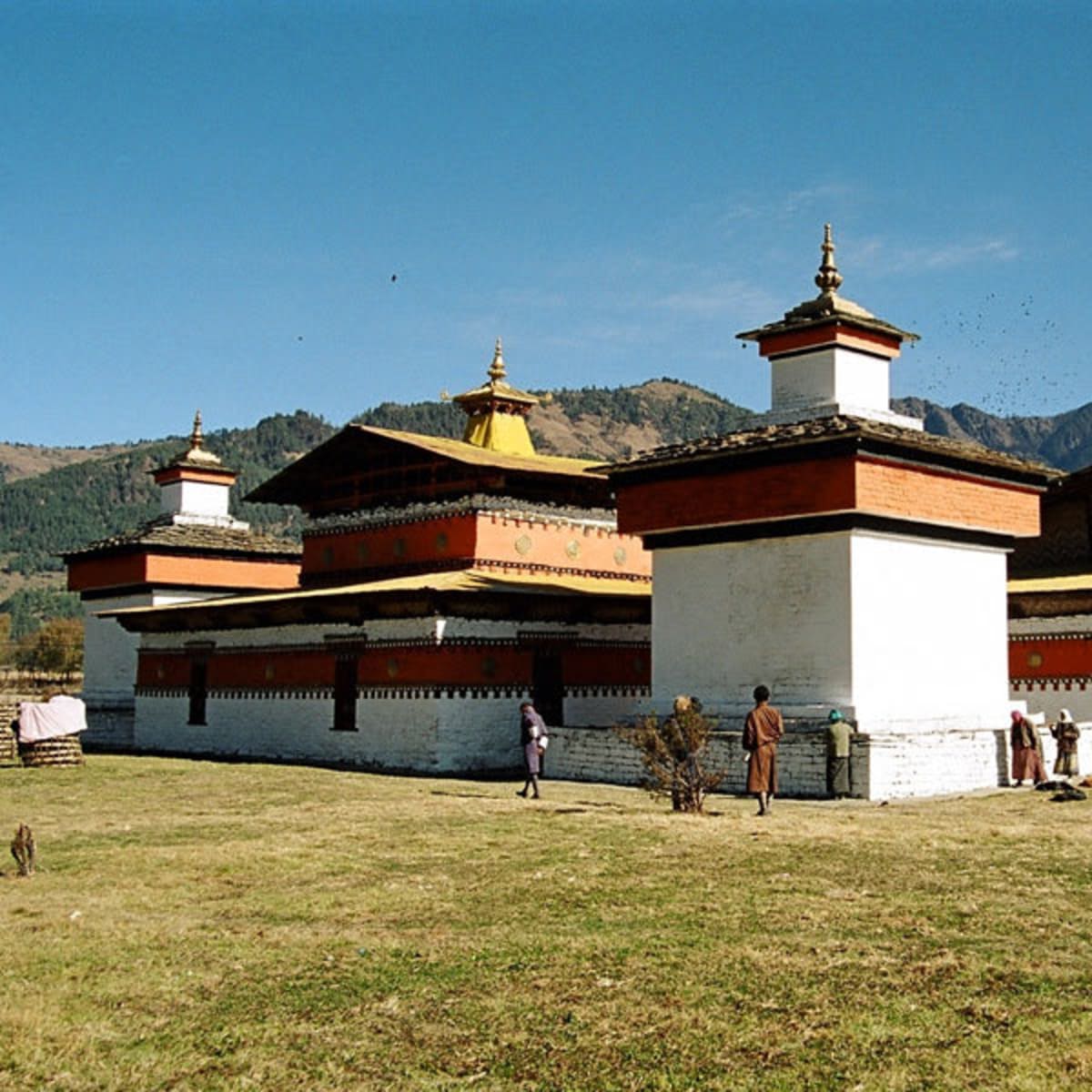
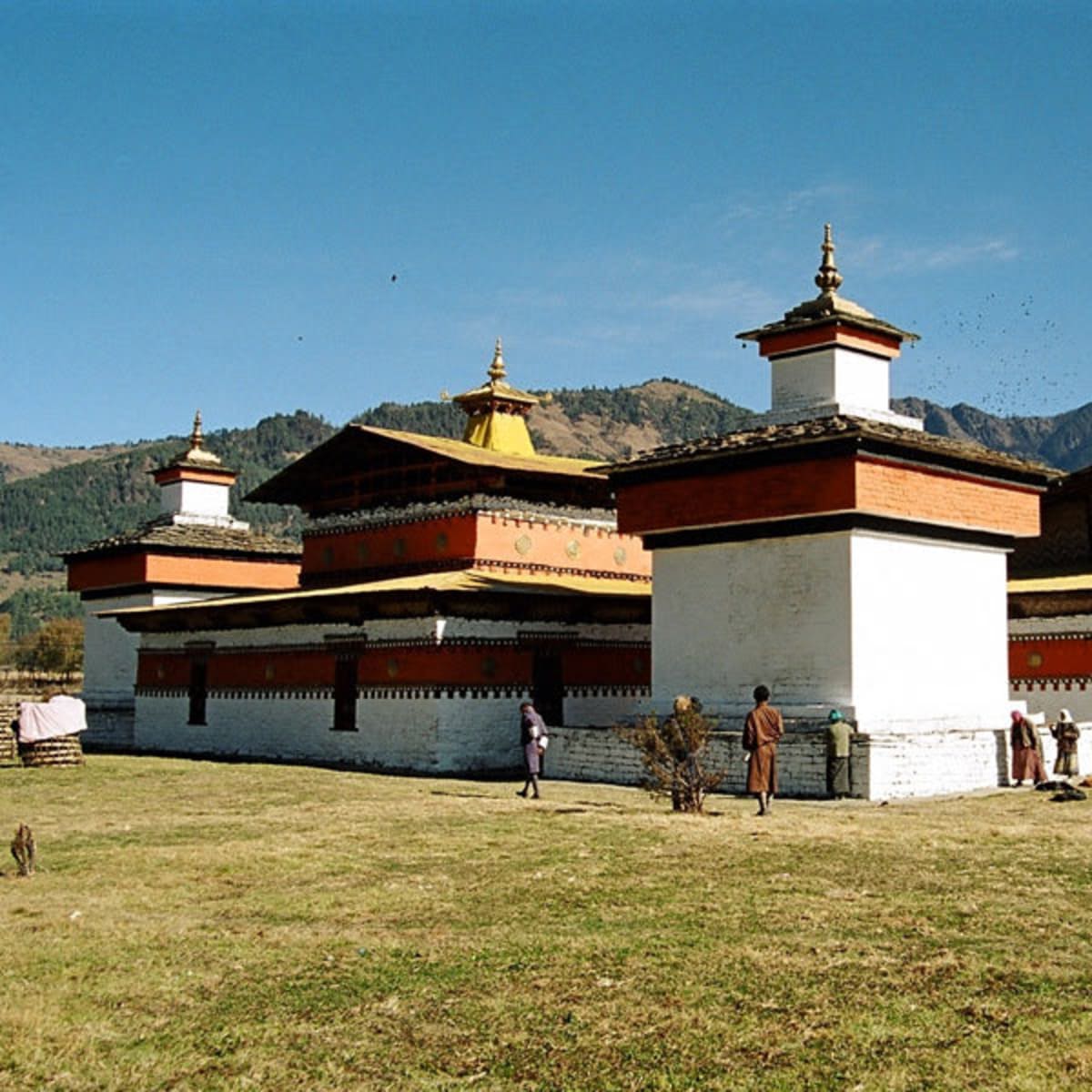
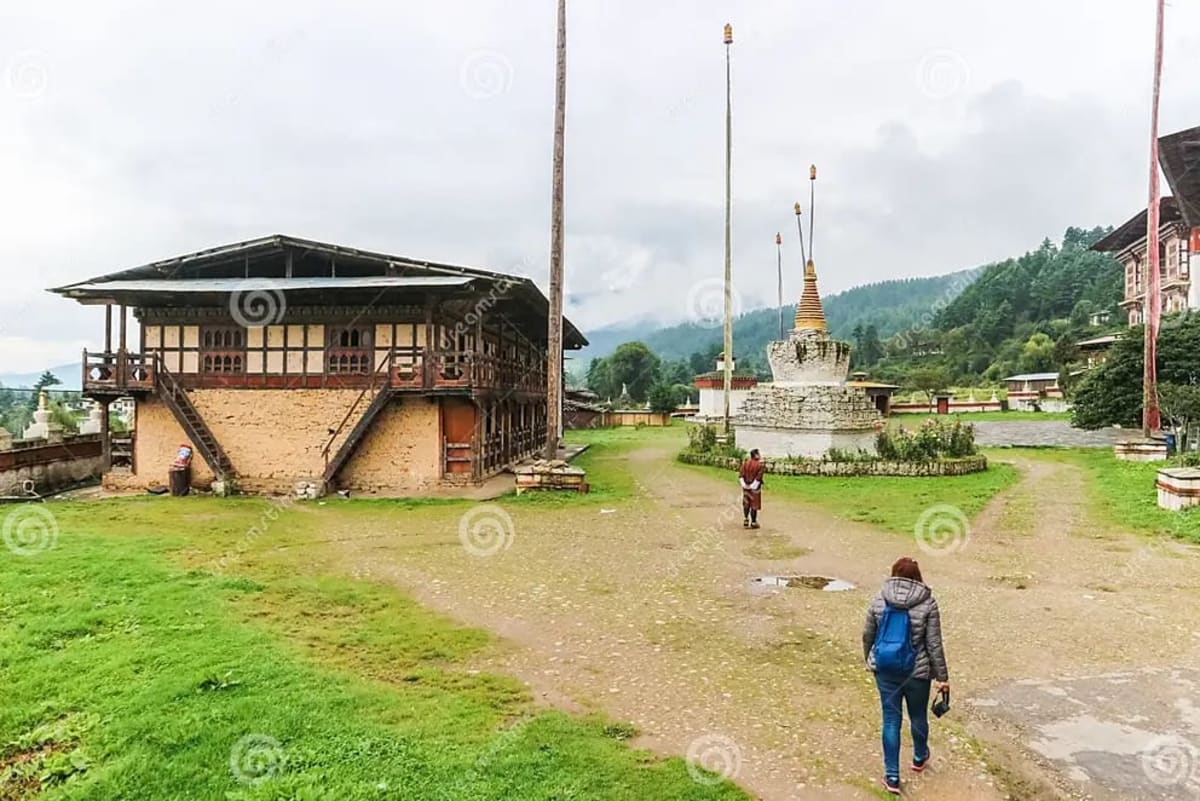
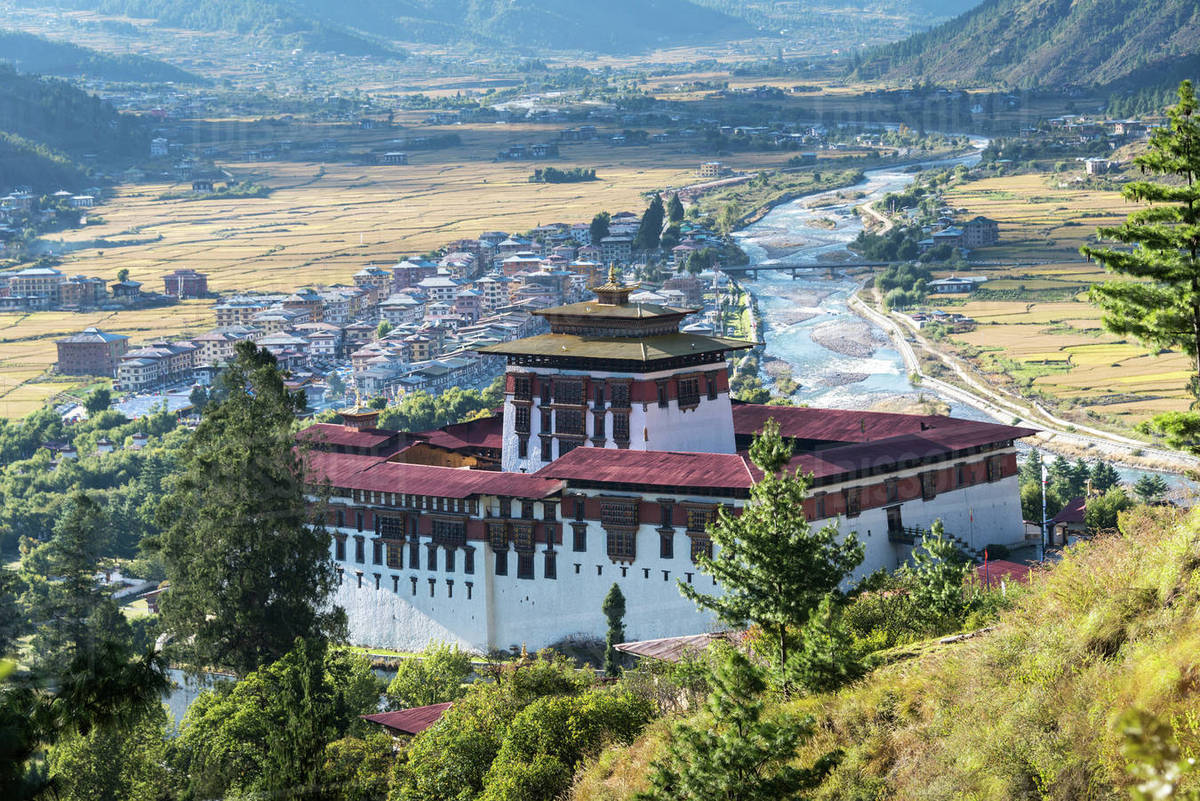
Chumey is the first of Bumthang’s four valleys if you come from Trongsa, a wide green trough of potatoes and barley and the smell of wool being dyed. Before you reach Jakar you pass houses where women throw the shuttle of the yathra loom without looking, because their hands have known the pattern since girlhood. Red, yellow, geometric fire — Chumey cloth is one of the signatures of central Bhutan. Nimalung Dratshang sits above this working beauty, a monastic house of the Nyingma school, of the lineage that runs through Pema Lingpa, the treasure revealer who is Bumthang’s own saint.
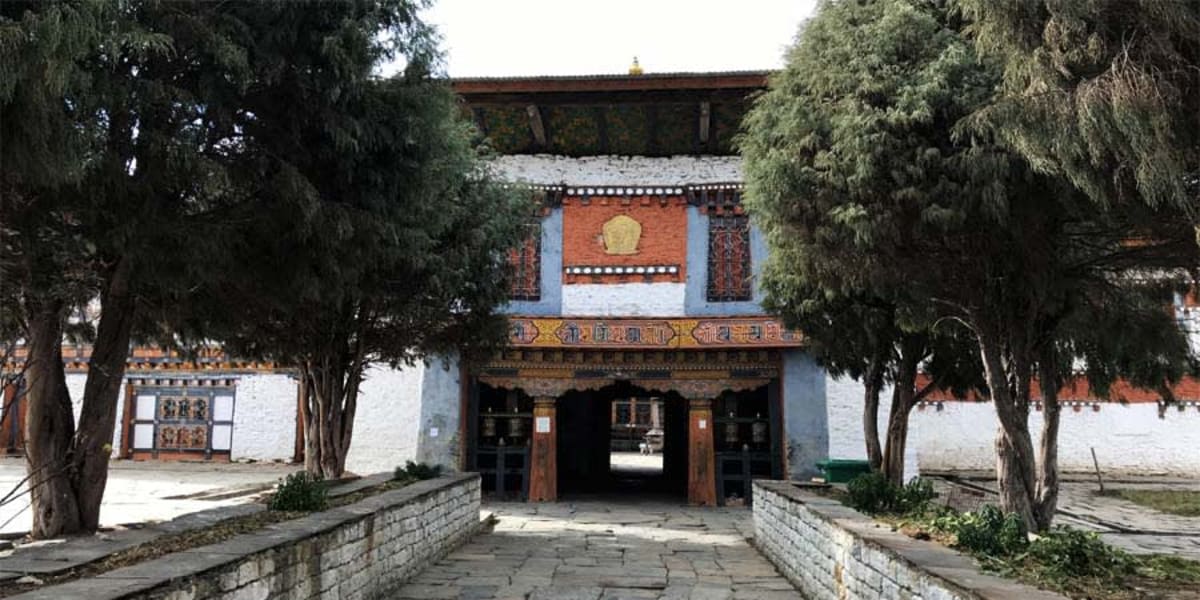
The dratshang is not a seventh-century pin in the earth like Jambay. It is younger, founded in the 1930s by a trulku of the Pema Lingpa line — Doring Trulku, with the support of local patrons — which is another way of saying it is old in spirit and local in bone. A reincarnate master of the treasure-revealer’s family planted a monastic house where the valley already knew how to make beauty with wool. The monks here are not performing a national pageant. They are keeping a household of practice in a place that also keeps sheep and looms. When the tshechu comes, in June or July according to the fifth Bhutanese month, the two households — the monastic and the farming — occupy the same courtyard without needing an announcement.
If you arrive the day before, you may hear the rehearsals: a drum behind a wall, a laugh, a khenpo’s correction. Boys run the gallery with costumes over their arms. An old woman from a weaving house sits in the shade winding thread and watching, as if the festival were another pattern she has the right to inspect. Chumey does not separate craft from ceremony. The same hands that throw a shuttle will, tomorrow, fold a scarf as an offering.
I like the drive into Chumey on festival week. Prayer flags thicken along the road. A boy in a gho too big for him carries a thermos as large as his torso. From the monastery terrace the valley is a map of work: potato fields in neat rectangles, the river a quick silver, smoke from kitchens where ema datshi is already thinking about lunch. Jakar Dzong, if the air is clear, is a white thought on a distant ridge. You are still in Bumthang, still in the spiritual heartland, but you are not in the postcard of Kurjey. You are in the valley that clothes the heartland.
The days the masks come down the steps
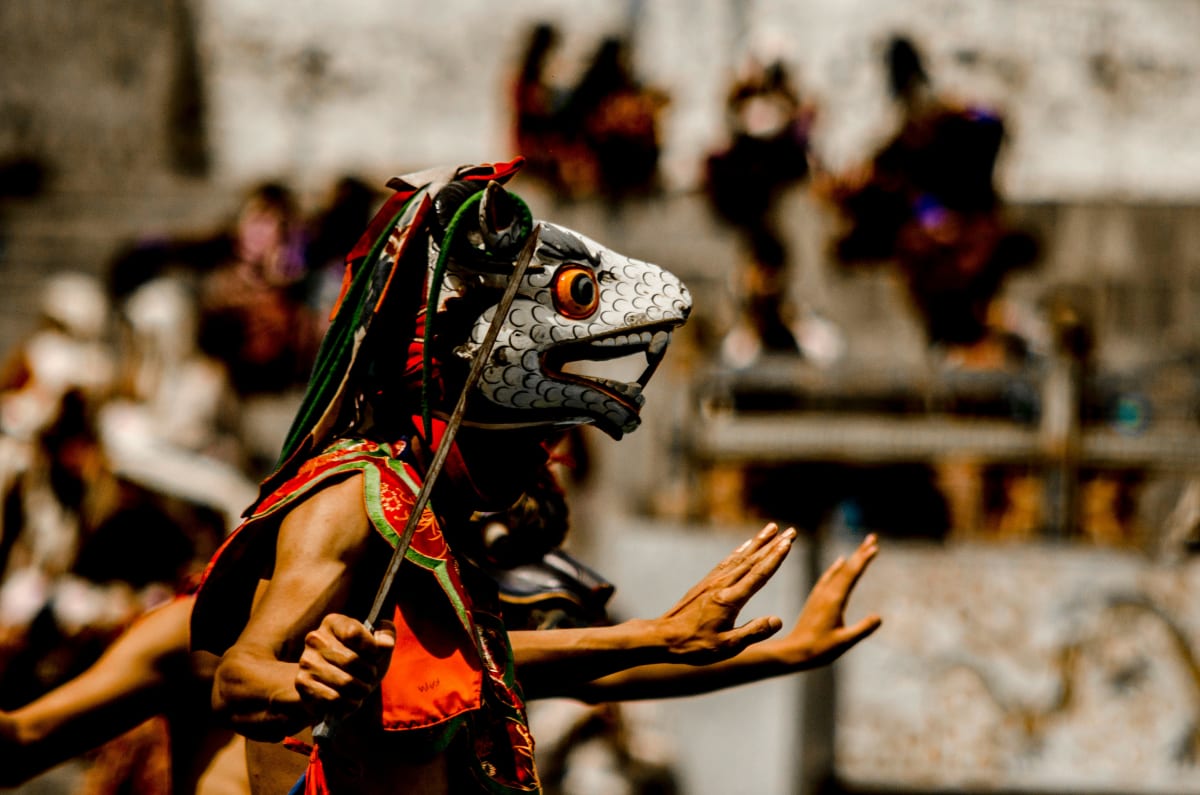
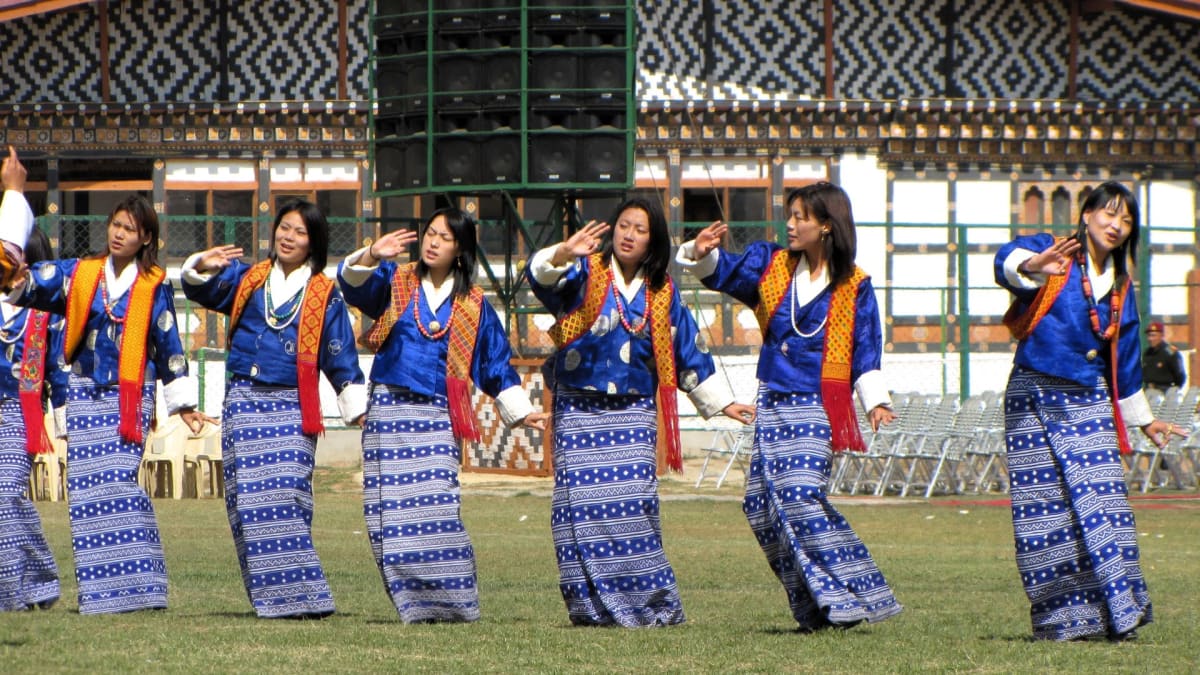
Nimalung Tshechu lasts a handful of days, which in practice means the valley rearranges its clock. Cham dances occupy the courtyard in the slow, turning grammar that anyone who has stood at a Bhutanese festival will recognize and that no one who has only watched a video will quite understand. The drums talk to the cymbals. A dancer in a wrathful mask holds a skull-cup and a dagger of painted wood, and for the length of the dance the wooden dagger is not a prop. The atsaras — red-faced, irreverent, necessary — keep the sacred from becoming brittle. They mock a tourist’s camera strap. They mock a village man’s new shoes. They mock, gently, the monk who is taking himself too seriously, which is a teaching disguised as a joke.
Pema Lingpa’s lineage is a lineage of terma, of things hidden and found. You feel that even when the dance is a standard cham of the Nyingma repertoire. The valley that produced a saint who dove into a burning lake with a lamp does not treat revelation as a metaphor. The thongdrel itself is a kind of terma made visible: a painting so large it can only be shown once a year, as if the eyes of ordinary days were not quite enough to hold it.
Nearby Prakhar, another temple of the same spiritual weather, often keeps festival time in the same season, and families move between the two the way they move between kitchens at a wedding. If you are lucky you will be handed a cup of suja, salted butter tea, by someone who does not know your name and does not need to. The hospitality of Chumey during tshechu is not a program. It is what the valley does when it has put on its silk.
Liberation upon sight
I try to get guests to the thongdrel the way I try to get them to a mountain pass at dawn: a little too early, a little cold, with the understanding that the thing they came for will not wait for breakfast. The unfurling is brief in clock time and long in the other kind. You stand in a crowd that is mostly Bhutanese, which is how a festival should feel. You hear the ropes. You hear a baby complain and then stop, as if even the baby understood the assignment. The Guru’s eight manifestations, or his central form, depending on the year and the cloth, occupy the wall like a second architecture.
What is liberation upon sight? The teaching says that to see a sacred image with devotion can plant a seed that ripens beyond this life. I am a guide, not a khenpo, and I do not pretend to unpack the philosophy on a courtyard flagstone. What I can say is what I have seen on faces. People who have been tired — tired from fields, tired from a long year, tired in the way a small valley can be tired — look up and for a moment are not tired. That is not a small thing. Whether you call it blessing or beauty or the relief of a community standing in the same direction, the thongdrel does work that a museum painting, behind glass, cannot do. It is public. It is perishable. It will be rolled up again before the sun is high, and the wall will go back to being a wall.
Afterward the dances continue. The masks come down the steps again. A man from the weaving houses stands with his daughter on his shoulders so she can see. The smell of oil and chili drifts from the stalls. In the afternoon heat — Chumey in June can be surprisingly warm — people sit in the shade of the monastery wall and gossip, which is also a liturgy, the liturgy of a valley catching up with itself.
When you leave Nimalung you drive back through the same yathra country, and the looms will still be ticking in the dark of the houses, because cloth does not stop for a thongdrel. That continuity is the point. The festival is not a break from Chumey. It is Chumey at full voice — Pema Lingpa’s current running through a twentieth-century dratshang, a painted Guru the size of a cliff, farmers and monks in the same dawn.
Nimalung Tshechu is held in June or July, on lunar dates that move a little each year, at the dratshang above the Chumey valley floor, a short drive from Jakar and an easy morning from the yathra workshops the valley is famous for. Come for the last day’s dawn unfurling if you can bear an early start; stay for at least one full day of cham so the cloth is not the only memory you take. Foreign visitors travel with a licensed Bhutanese operator, dress as they would for any temple, and leave the flash in the bag. The courtyard is modest. The blessing is not. If you stand there when the thongdrel falls, you will understand why Chumey, which could have been only a weaving stop on the road to Bumthang’s older temples, is a destination of its own — a valley that knows how to make a pattern, on a loom and on a wall, large enough to see you.
Send your dates
A festival stay is about USD 1,100 per person. Ten private days for two is about USD 2,600–2,700 per person. The fee is included.